



Ch18-Moksha-Sanyasa-Yoga
 Bhagavad Gita at Work
 Ch18-Moksha-Sanyasa-Yoga

Verse 55-60
The one who is not Brahmabhuta has made three decisions:
1. Jivatma is performing actions with ego through mind
2. Mind energy is trying to connect to Brahman
3. Bhakti is always entangled with asking for something from Bhagawan.
The things which are related to this sansar, which is full of Sukha and Dukkha.
1. Gyani Bhakti is without deenta. Mind is attached to Bhagawan – then that person is called Brahmabhuta. He/She is still not reached the state of Brahman.
2. Whatever is happening in our life is due to your blessings.
3. But this stage can also change and become deena bhava.
4. Once this stage become permanent, then that person is Brahmabhuta. There is no deenta. Myness bhava is negligible.


Chapter 18 – Moksha Sanyasa Yoga
Verse 2
Bhagawan is saying: People say that the one who does not perform any actions out of desires is called Sanyasi. The one who performs actions without attachment to results of actions is called Tyagi.
Verse 3 - Some people say that all karma – actions should not be performed. But actions related to the yagya, sacrifice (tapa) and daan (donation) should never be revoked. Even these three karmas must be performed by the Brahma Chari who is in the state of silence with no attachment to desires.
Yagya – actions performed for the benefits of others without attachment (no Bandhan)
Daan – for benefits of others
Tapa – Purification of your atma (Chitta) to continue to state of silence (enlighten)
Verse 7 - All actions related to niyat (prescribed) Karma must be performed. For example, prescribed karmas for an iron smith must be performed to take care of his family. Prakriti (nature) always takes you towards a balance state.
Verse 7-11
There are three things:
1. Desire
2. Karma
3. Karma-Phala
Performing actions is fine. The results of actions are positive or negative. Karma is bound by Rajas. The results of actions decides whether it is Rajas, Tamas or Sattavik. Jnana (Gyan) is related to Sattavik. You are performing your actions to get results is rajasic, but you did not heart others. But if you hurt someone then it is Tamsic. When you do not hurt others through your actions without attaching to the results of actions is called Sattavik. How do you address the desires arising out of prakriti kriya that starts the beginning of actions? You cannot get away from actions if you are Deh (body, mind, and soul). If I am performing actions, I am Karta. This is being talked about with reference to Niyat karma.
Even though you start moving beyond the “I as Karta”, your Deh will still have to perform actions. When you start moving towards giving-up desires, then you start towards the path of spirituality. Bhakti is essential in Kaliyuga because general vibrational state is of lower level. This is why we must conduct Bhajan, Stuti, Havan and Kirtan.
Verse 9-10 – Renunciation of karma-phala or attachment to karma-phala is called Sattavik. Bhagawan has already addressed this in Chapter 2 about the Traya gunatmik sansar. Hey Arjun – I want you to move beyond this Traya Gunatmik sansar. In this Sansar, you must perform niyat karma. Slowly you move towards Sattavik state. Dharana, Dharan and Samadhi – then you reach towards Pragya that takes you towards Bhagawan Krishna. Then, you are established in niyat and perform actions related to Tyagi or Sanyasa. Ultimately your focus should be to discover your True Self, which is beyond three-gunatmik Sansar and duality.


The Bhagavad Gita Chapter 18 serves as the conclusion of the sacred conversation between Lord Krishna and Prince Arjuna on the battlefield of Kurukshetra. In this chapter, Lord Krishna imparts his final teachings and guidance to Arjuna, summarizing the key concepts discussed throughout the previous chapters.
Lord Krishna emphasizes the importance of renunciation and selfless action, stressing that true liberation comes from performing one's duties without attachment to the results. He explains the threefold path of action (Karma Yoga), knowledge (Gyan/Jnana Yoga), and devotion (Bhakti Yoga), highlighting that all paths ultimately lead to the same goal of self-realization and union with the divine.
The chapter delves into the concept of varnas based on traya gunnas (Rajas, Tamas and Sattwa) and Karmas and ashramas (stages of life - Childhood, Young, Family and Vanaprastha - discovering True-Self), outlining the duties and responsibilities associated with each. Lord Krishna emphasizes the importance of performing one's prescribed duties according to one's nature and presence in life, rather than seeking to abandon them in pursuit of a different path.
Bhagawan Shri Krishna also discusses the three types of knowledge – knowledge of the field (the body and material world), knowledge of the knower the Soul, Ultimate Reality - Brahman, and knowledge of the knowable. Bhagawan Shri Krishna explains that true wisdom lies in understanding the interplay between these aspects and recognizing the eternal nature of the soul beyond the transient material world.
The chapter concludes with Bhagawan Shri Krishna encouraging Arjuna to surrender fully to him and to follow his teachings with faith and devotion. He reassures Arjuna that those who faithfully adhere to his words will attain liberation from the cycle of birth and death and achieve ultimate union with the Brahman.
In essence, Chapter 18 of the Bhagavad Gita encapsulates the core teachings of the text, emphasizing the importance of selfless action, devotion, knowledge, and surrender to the Brahman as the path to spiritual realization and ultimate liberation - discovery of your True Nature.
Chapter 18 – Moksha Sanyasa Yoga
Verse 12
The person who is performing actions motivated by the rajas and tamas must wait for the results after leaving this body.
· Karma – agent of actions
· Karma-phala
· Attachment to Karma-phala
If a person is entangled with the above three items, he/she gets the results of actions.
Verse 13-14
Daivam – impressions given to you according to your karmas. Jiva is established as a dehi. Jiva (Jivatma) continues to be attached to the next deh and in between. My impressions continue to be attached to my Cit according to my experiences (vasanas, impressions, bandhan, desires). When this Jiva takes new deh – karma-phala start getting fructified in this new deh.
Sukhaa-Dukkha – how do you comprehend this?
The events are occurring according to nature.
Krama-phala: All emotions in your Cit are a signal to you that you need to take care of it. All impressions in your Cit need to be addressed. As Cit gets purified, your emotional attitude starts getting balanced.
If we are attached with Aham based on Cit, we are identified with nature (prakriti). But when we get our Cit purified then Aham gets attached to the Brahman.
Actions, Indriya, Agent of Actions, Place are given to you according to your karmas. As soon as I can distinguish myself from Prakriti, I can move above the Prakriti. This way we can start moving above Aham.
The karma-phala starts getting fructified when Jiva starts acquiring new deh. A lot of karma-phala gets fructified in the formulation of body.
Verse 15-16
When you start doing dharana, pratyahara, meditation your start acquiring new ideas that there is more than deh in this external world. Your desires get intensified to discover source of permanent happiness.
Any person lives in this physical world at two levels – physical and psychological level.
Usually, a person starts getting rid of dukkha (feeling) and starts moving towards Bhagawan and desires Sukhaa.
Slowly a person starts realizing that Sukhaa and Dukkha are related to your Bhava. Some people give up and say what is the use of moving beyond Sukhaa-Dukkha? Others look at what is the point behind the search of permanent happiness?
Adhyatma (Spirituality) – using all instruments in this birth we want to discover your True-Self. You are reaching near Atma.
Para Shakti is related to Atma and Parmatma
Apara Shakti is related to mind - Gyan (Jnana) and Vigyan. (Jijnana)
Chapter 18 – Moksha Sanyasa Yoga
Verse 22-32
One can evaluate himself/herself about the actions performed by us. You can be Sattavik most of the time and can be Rajasic sometimes. As a Sattavik, you handle situation without getting entangled in it. You try to maintain the balance in dealing with others according to Prakriti.
When you say I am tall, I am intelligent, I am beautiful implies that I am under the influence of “Aham”. When you perform actions with the perspective that I am not the agent of actions even though I am doing it (I am aware of this bhava). The spectrum of color changes as you move from Tamas to Rajas to Sattavik.
Once you start expanding your awareness in this sansar, you start getting answers to your questions. The process of expanding awareness gets you towards experiencing the stages of spiritual journey.
If you start observing events happening outside – observing children behavior, then, you start observing your own behavior.
Bhagawan is teaching Arjun (Kshatriya) in Kurukshetra – how to perform your dharma in this Kurukshetra. Swarup has no Bhava. In Swabhav – you have Bhava. As a human being how do you reach in Bhagavan’s Sharan. There is an effort that one must make to move from Swabhav to Swarup.
Verse 33-40
Self-discipline is required to move towards Sattva. Your mind must be trained to choose Shreyas (Kalyan Kari) or Preyas (Priya). Shreyas will take you towards permanent happiness. When Shreyas becomes Preyas, then you achieve self-discipline.
Verse 17-22 – When a person is fighting with the enemy with the Bhava that he/she is not the agent of actions. Such a person is not bound by the killing. That person is not the doer. In Indian army training, the value system is attached to lower the effects of stress/trauma. When ownership of action goes away, the karma-phala is detached.
Dwait exists because of Aham. I am there and then there is something else. The cycle of karma starts according to three-gunnas. In spirituality, one must move beyond these three gunas.
The way to get rid of Aham is to focus on removing vasanas from the Cit. As Cit starts purifying the Aham gets diluted and eventually we move beyond three-gunnatmik sansar. When you become the light, you are in Adwait. There is no “I” and you become Brahma.
Dharma Kshetra and Kuru-Kshetra – this is how Bhagavad Gita starts. Bhagawan is saying that Gyan (Jnana), Karma and Karta exist in this Prakriti (Creation of Parmatma). In this Kuru-Kshetra we are all entangled in daily activities. Our ultimate goal is to recognize your “True-Self”.
Karma will culminate in Gyan (Jnana), which is My Swarup. Your focus is to become yogi. Start moving towards the path of realizing your True-Nature. You should perform your actions according to scripture Gyan (Jnana). You can only try/make efforts to move beyond the three-gunnatmik sansar.
Dharma – Mam Dharma.
Bhava-Sagar: The sea of existence (prakriti). My identity must move beyond prakriti towards Brahman.
In Gyan (Jnana)-Samadhi: One should observe that one Satya exists in everyone. In this sansar, Deh takes birth and dies. The one Atma (True-Self) that lives with every Deh is unborn and uncreated.
Bhagavad Gita Chapter 18 – Moksha Sanyasa Yoga
Verse 32-45
Jivatma journey continues to take birth according to its Prarabdha Karma (Results of karma’s yet to be fructified) till he/she attains enlightenment. Sanchit karma’s also keeps adding events.
Agami Karma – the actions that you are going to perform. As you progress towards Gyan/Jnana related Karma, then you can change the reactions of Prarabdha and Sanchit Karmas and they get purified. Maan shudhi affects Prana shudhi that slowly improves the flow of energy to the upper chakra. For example, if you feel jealous, angry it will directly affect your Manipura Chakra – identity/ego. Propagate attitude of unconditional love and forgiveness, you will improve the flow of energies towards higher level chakras. As soon as you start your “vichars” moving towards Sattavik thoughts, you start affecting Prana and Prana becomes purified and your upper chakras start getting purified.
Verse 33
Those persons who are already established in yoga where you are focused on Brahman, then that person focuses on his/her Indriya, maan and prana in Parmatma. Once you are established in yoga system then Prana starts getting purified and your journey starts towards enlightenment. Atmatatva established in Parmatatatva will allow you to perform all actions due to influence of Bhagawan.
Bhagavad Gita Chapter 18 – Moksha Sanyasa Yoga
Verse 49 – In normal life one should focus on the process (actions) not on the results. This allows you to increase the efficiency of performing actions. The training of mind in such a fashion enables a person to get detached from the intellect. When the results are not there and you are not disappointed, then arrogance starts diluting.
Yogah Karma Sukaushlam – I am performing this action with Tatparta and Madparata. You are focused on process of actions and not the results of actions. Slowly your mind starts getting attached to the process. Then, you are focused on the process of actions. When you are attached to the idea that I am not the owner of actions. I am not the doer of actions, then you are moving towards spirituality. Now spirituality controls the physical aspects of performing actions. Now we are living with this Bhava in your daily life activities.
Verse 51 – 53
Mind is the ultimate source of actions. These actions come from the vritti. When you start creating the situation where you are untouched by the actions performed by the force of three gunnatmik sansar, you are on the path of spirituality. In spirituality, pull to reach higher goals is important – inspired actions.
Verse 46
We (Swa) take birth in this Traya Gunnatmik Sansar due to our own Swabhav (Karma + Karma-Phala; the desire is attached to this Karma). The Rishi (Krishna) is saying that you need to focus on your own Swabhav (kshatriya, Vaishya, Shudra). You need to continue doing your work and try to discover the ultimate Truth. I have created my Swabhav knowing that I am not that. I am Swa. Then we can start the journey towards the discovery of your True Self (Swa) through your own Swabhav (my Sukshma shareera, Stuhl shareera and Karan shareera do not allow me to realize Swa). By focusing on your own Dharma (Swabhav) continue your journey while established in Brahman.
When Atmatatva comes in this Sansar, it becomes a projection of Chitta with its Swabhav. This Swabhav is considered as Atmaram. When a person is performing actions according to its own Swabhav – like a technical person will enjoy the work if he/she is not put into management. You find yourself happy when you work according to your own tendency. Similarly, when you start your spiritual journey, you should act according to your tendencies. But your tendencies change as you acquire more knowledge. Swabhav is the path to reach Swa – Karma yogi, Bhakta yogi, Gyan/Jnana yogi will adopt its spiritual journey according to one’s Swabhav.
Sometimes we get driven away by the glamor part of the other Swabhav, which will not be helpful because your nature/Swabhav is different – like football player is put on the baseball team will miserably fail.
Self-actualization (Swabhav) will lead you towards Self-realization on a road to Spiritual journey.
Bhagavad Gita Chapter 18 – Moksha Sanyasa Yoga
Verse 54 (summary of shloka 49-53)
Bhakti – Madbhakta; Gyani/Janani – Brahmbhuta
Upper four chakras have their own power.
Heart Chakra – realization of oneness; Time is still involved; Unconditional love. Bhakti affects Heart Chakra.
Third Eye – you are beyond the effect of time. Your ignorance is destroyed – Maya (three gunnas). As we move towards Gyan/Jnana, the layers of ignorance get destroyed.
Crown Chakra – This realization is related to Brahmabhuta. This is your True Nature. Here, Gyan, Bhakti and Karma yoga get together.
All these four chakras are related to spiritual journey. Heart chakra is a balancer between the lower three and upper four chakras. The lower three chakras are related to mind and stays in this Sansar. The upper four chakras start from mind, but it starts moving beyond mind. The Bhakti is like a Lighthouse providing direction towards Parmatma.
All karmas get dissolved into Gyan/Jnana.
Verse 49-53
Bhagawan is teaching the processes to reach Me (Parmatma). Abhyasa and dispassion both are required. Slowly, you need to move away from Tamas, Rajas and Sattavik gunnas. Then, purify your Gyan/Jnana to discover Pragya. Then, you move away from ego. Continuous Dhyana.
Every person can use Rajas gunna power to move away from Tamas gunna and attach to Sattavik gunna. Then, you start attaching to Parmatma – all these karmas make you Karma Yogi. Yagya – the real tattva (ya to know; gya – Gyan/Jnana). I exist with five karma indriyas and five Gyan indriyas and Atma. You need to fight for your existence. Your intention defines the quality of your actions.
Actions performed with intent towards Parmatma – then intention starts getting purified. Slowly, you move away from this Sansar and start becoming a Karma-yogi.
General Discussion and Prioritizing Topics to Experience Learnings from Bhagavad Gita
Goal: I will control my emotions – do not allow others to control my emotions – anger, jealousy, frustration etc.
Sanatan Dharma: Discovery and Inquiry of the Ultimate Truth
Verse 49 – 53
Verse 49 – In normal life one should focus on the process (actions) not on the results. This allows you to increase the efficiency of performing actions. The training of mind in such a fashion enables a person to get detached from the intellect. When the results are not there and you are not disappointed, then arrogance starts diluting.
Yogah Karma Sukaushlam – I am performing this action with Tatparta and Madparata. You are focused on process of actions and not the results of actions. Slowly your mind starts getting attached to the process. Then, you are focused on the process of actions. When you are attached to the idea that I am not the owner of actions. I am not the doer of actions, then you are moving towards spirituality. Now spirituality controls the physical aspects of performing actions. Now we are living with this Bhava in your daily life activities.
Verse 51 – 53
Mind is the ultimate source of actions. These actions come from the vritti. When you start creating the situation where you are untouched by the actions performed by the force of three gunnatmik sansar, you are on the path of spirituality. In spirituality, pull to reach higher goals is important – inspired actions.
Bhagavad Gita Chapter 18-Moksha-Sanyasa-Yoga'
Verse 54 - 55
The one who is not Brahmabhuta has made three decisions:
1. Jivatma is performing actions with ego through mind
2. Mind energy is trying to connect to Brahman
3. Bhakti is always entangled with asking for something from Bhagawan.
The things which are related to this sansar, which is full of Sukha and Dukkha.
1. Gyani/Jnanai Bhakti is without deenta. Mind is attached to Bhagawan – then that person is called Brahmabhuta. He/She is still has not reached the state of Brahman.
2. Whatever is happening in our life is due to your blessings.
3. But this stage can also change and become deena bhava.
4. Once this stage become permanent, then that person is Brahmabhuta. There is no deenta. Myness bhava is negligible.
Verse 54
Brahma-bhutah – Arjun can become Brahmabhuta. He is not there yet. Once you reach to the state of Brahmabhuta, you can become part of same Brahman and start experiencing the Parmatma while being in this state entangled with five elements and three gunnas. Once you are in the state of Atmatatva, you become Prasanna Atma. Now you are desireless, painless.
This body is Kurukshetra. Five sense organs are attached to external world activities. All teachings are meant for us. Yatha Pindey Tatha Brahmandey. Everyone focus is to become Brahmabhuta.
Your Bhava (pleasurable or unpleasurable) become manifested in your Chitta based on your past experiences. These impressions can be erased as well. But “YOU” are the same before the past experiences and after the experiences. All impressions are temporary. Your real “YOU” is same. That state is Brahma-bhutah. The moment you realize that I am before impressions, you will still be entangled in daily activities. Normally, we start from the impressions and get entangled in three gunnas. Once you realize that I am the one before the impressions, then you can start behaving like a Brahma-bhutah while entangled in this sansar.
Akash – Vibrations, Swar activates one sense
Air – Sparsh – produces sound Swar
Fire (Agni) – See (Akash + Air + See)
Water – Taste (Akash + Air + Agni + Taste)
Earth – Smell (Akash + Air + Agni + Water + Smell)
Once these five tattva activate five senses and we start experiencing this sansar.
How do I become Brahma-bhutah?
· Purifying (Chitta-shudhi) ourselves is in your hand – Aham and Vaham is removed when Maan becomes Nirmal. All yoga processes are oriented to help people with all three nature – Sattva, Rajas and Tamas. Bhajan, Daan, Service to others.
· The one who has made his/her mann Nirmal – through Karma-Yoga, Gyan/Jnana-Yoga (Nirguna-Brahma), Bhakti-Yoga (Saguna-Brahma).
· OM is closest to Brahma – A (Nahi), U, M (Prakriti – Uma).
Verse 55
The one who knows my True Nature, enters Me.
Chapter 18 – Moksha Sanyasa Yoga
Verse 66
The one who is not Brahmabhuta has made three decisions:
- Jivatma is performing actions with ego through mind
- Mind energy is trying to connect to Brahman
- Bhakti is always entangled with asking for something from Bhagawan.
The things which are related to this sansar, which is full of Sukha and Dukkha.
- Gyani Bhakti is without deenta. Mind is attached to Bhagawan – then that person is called Brahmabhuta. He/She is still having not reached the state of Brahman.
- Whatever is happening in our life is due to your blessings.
- But this stage can also change and become deena bhava.
- Once this stage become permanent, then that person is Brahmabhuta. There is no deenta. Myness bhava is negligible.
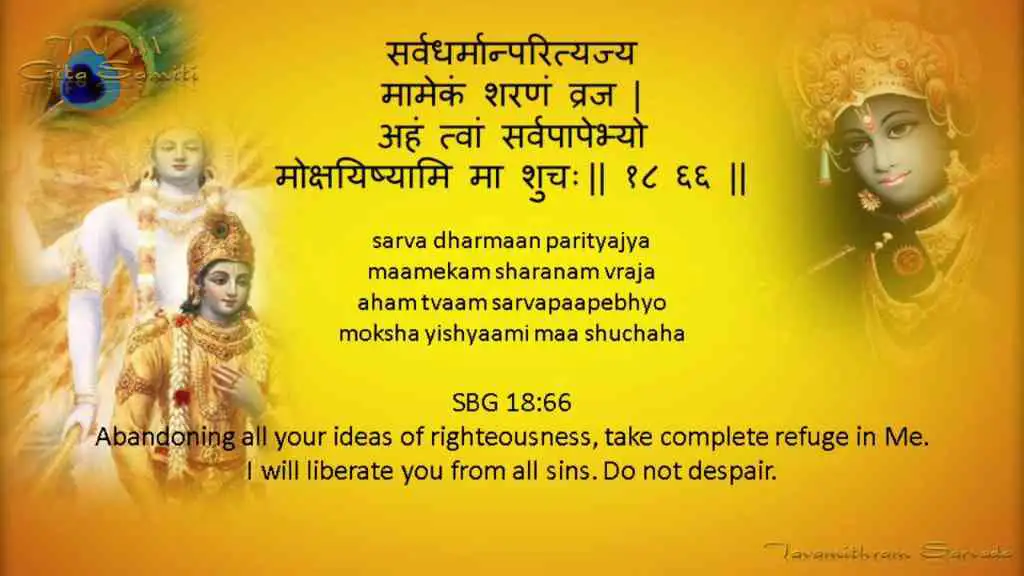
Verse 66 – Bhagawan is saying that you come to my refuge. Bhagawan is manifested God (saguna) for Bhakta. When we look through the angle of Gyan/Jnana then we can call Him as Parmatma. Bhagawan as nirgun Brahman is not entangled with any activities. If there is an owner of the action, there is an action. When myness is gone, there will be Kriya but no Karma. When you are not the Karta, there is no Karma and no Karma-phala. Dharma cannot be performed without Karma.
Dhri -> Dharma -> the nature is held by Dharma. All roles in human being require mind and intellect. Dharma is required to make sure that you are not following animal instinct.
Responsibility is to follow the purity of Dharma.
Tyaga has conditions: Physically – you should have that available – sweets, snacks etc. It should be likable. It is Prayus vs Shreyas. It should suit you.
To Tyaga Dharam –
- You should follow Dharma.
- Dharma is related to Sattavik Gyan/Jnana (budhi); Tamsic budhi has no Dharma (Tamsic Dharma); You are following Dharma with Sattavik budhi.
- You are following Sattavik Gunna – you are following Dharma with Sattavik Gyan; Now you get rid of all Gunnas and go beyond three Gunnas and come to Me. You perform your actions without being LYPT (entangled) in it.
- You go beyond the realm of mind and intellect.
- Now all actions performed by you in this stage has no actions or results of actions.
- Papa karma is the one that takes you downwards.
Sanatan Dharma is a personal development-oriented Dharma. We are engaged in this world at three levels:
- Entangled in this world activities
- Devoted to Bhagawan – Bhakti (Bhava is Dhanyo-Aham (Gratitude) you move from lack of things to abundance
- Discoverer of True Self – Who we are?
This way your divine connection become stronger when you have Shradha. You are full of Gratitude – your life becomes more Sukhmayi. You start looking at everything with positive bhava/attitude. Grass is greener. Show gratitude, so that your sansarik Jeevan become beautiful. Slowly you start developing Shradha.

