



Woodland Birds
 Birds of Telangana
 Woodland Birds

Woodland birds are species that depend on tree-dominated habitats such as forests, groves, and wooded edges, using the mix of canopy, shrubs, and ground layer for feeding, nesting, and shelter throughout their life cycle.


Painted Spurfowl
Slightly smaller than a domestic chicken. The brightly colored male is unmistakable with dense white spots while the female is more drab brown overall. This is a bird of the rocky and scrub forest habitats in the Indian peninsula and is mostly found in pairs or in small groups. Birds are generally shy and not very vocal unlike other members of the family. When disturbed, they scuttle through the undergrowth and rarely take to the wing. It give a loud, rapidly repeated “chur, chur, chur” and the male also gives a bubbling, clucking “chugak” when flushed ..


Common Hawk-Cuckoo
A medium-sized bird that resembles a Shikra in plumage. Males have ashy-gray upperparts, white underparts with rufous streaking and barring, a broadly barred tail, and a distinct yellow eye rim. Females and juveniles are browner with bolder streaking below. During their breeding season males produce a loud, repetitive three note call. Common Hawk-Cuckoos feed mainly on insects and are specialised feeders that can handle hairy caterpillars. The species is arboreal and rarely descends to the ground. Mainly a brood parasite of babblers. Found in gardens, groves, and deciduous and semi-evergreen forests.
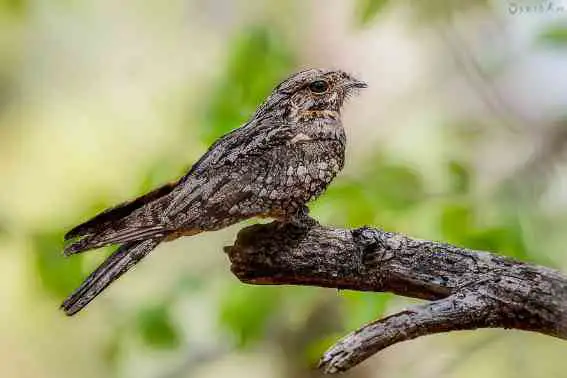
Jungle Nightjar
Gray-brown nightjar of wooded, open grassy, and scrubby areas; not restricted to jungles. Intricately patterned, with a golden patch behind the ear (often not visible on a resting bird) and pale tan spots on the wings. Male shows bright white patches near the wingtips and on the edges of the tail that are buffy-brown in females. Similar Savanna Nightjar is much more densely patterned and lacks the tan wing spots; Savanna also tends to roost on the ground, versus in trees for Jungle Nightjar. Song is utterly alien-sounding and unique: a long series of bouncing “pooKIHpooKIHpooKIH” notes, comparable to a cartoon laser gun.
Crested Treeswift
A medium-sized swift-like bird with long tail-streamers. Adult has a dark greenish-blue crest visible while it perches, mostly on trees. It has uniform pale gray upperparts, black lores with a fine white border above, and much rufous on the face of the male. Underwing feathers, breast, and flanks are pale gray, and belly is whitish. Female has a dark mask, replacing the male’s rufous coloration. The species is partial to lightly wooded country, avoiding open plains and wet forests. Mostly seen on the wing, and at times perched, making a characteristic “gek-kuk” call.
Oriental Honey-buzzard
A large raptor of lowland and montane broadleaf and mixed forests, this species is well-known for its tendency to congregate in large flocks of up to thousands during migration. Resident populations inhabit tropical forests from lowlands up into montane areas. While showing considerable plumage variation throughout its range, the combination of an unusually small and slender head, long striped tail, broad wings, and well-striped underwings make this species fairly recognizable across a wide area. True to its name, this species is a raider of wasp and bee nests, although it prefers bee and wasp larvae over their honey.
Crested Serpent-Eagle
A rather large, heavily built eagle with a dark, white-tipped bushy crest that gives it a distinctive large-headed look. When raised in alarm, the crest frames the whole face, highlighting the bare yellow lores and eyes, making the head look larger and fiercer. The rufous-brown underparts have neatly arranged dark-edged bold white spots. In flight, shows broad rounded wings with a wide black trailing edge. Juvenile predominantly white with dark streaks below; also note dark mask. Commonly seen perched upright in well-wooded areas, with wingtips nearly covering the broad white sub-terminal band on the tail. Its 1-3 note scream is often heard in the forest..
Changeable Hawk-Eagle
Medium-sized eagle with massive rounded wings. Appears very small-headed in flight. Name is slightly misleading, as there are only really two color morphs, pale and black. Pale-morph adult is dark brown above with a white breast overlaid with dark streaks. Juvenile is much paler, with cleaner white underparts and less extensive striping and barring anywhere on the body. Dark morph is dark all over with paler outer wing feathers, and can be mistaken for dark Honey-Buzzards; look out for the hawk-eagle’s much longer wings and more slender profile. Inhabits forests, forest edges, and expansive parks and plantations.
Black Eagle
Large and distinctive dark eagle of forested mountains and hills. Adults appear all dark from a distance, but closer inspection reveals pale barring on the primaries, secondaries, and undertail, as well as a bright yellow bill and feet. Readily separated from other large birds of prey in range by structure as well as coloration; Black Eagles have broad wings with distinct “fingers”(emarginated primaries) in the tip, as well as a long tail that is fan-shaped when open and slightly wedge-shaped when closed.
Indian Scops-Owl
Medium-sized scops-owl with prominent ear tufts and dark eyes. Coloration variable, ranging from gray to brown, but dark eyes, thin black border around the facial disc, and lightly streaked underparts remain constant. Gives bouncy amphibian-like barks at changing intervals. Inhabits forests, forest edges, parks, and gardens from lowlands up into foothill and montane regions.
Oriental Scops-Owl
Smallish scops-owl with bright yellow eyes. Comes in grayish-brown and bright rufous morphs. Generally weakly marked, without any prominent features: note weak black border to the facial disc, thinly streaked underparts, and short ear tufts (often held flat). Song is a 3- to 4-note series of hollow-sounding notes, with the last two in rapid succession. Inhabits forests, gardens, and parks from lowlands up into foothills; often close to human habitation in parts of its range.
Jungle Owlet
Squat little owl with dense barring all over the body. Lacks the false eyes on the back of the head possessed by many other owlets. Gives bursts of loud hollow trills, comparable to barbets, as well as a mellow “kaaaooo-kaaaaooo-kah-ow!” A forest species, found in densely wooded areas in lowlands and foothills. Most active at dawn and dusk.
Mottled Wood-Owl
Medium-sized patchy-looking owl with dark eyes. Densely-marked orange-and-gray coloration is unique. Typically gives single hoots, but also gives an odd, mellow tremolo vocalization in the breeding season. A lowland species, favoring groves and clusters of trees in open plains and on the edges of cultivated areas.
Coppersmith Barbet
A small, widespread, and cute little barbet with streaked underparts and a well-patterned face. Most populations have a red forehead, yellow around the eye and throat, and a black eyestripe all bordered at the rear of the crown by a black band. Also note red “badge” on upper chest. Female averages duller than the male, with some yellow on a narrower red “badge”. Immature lacks all red and has faint streaking on the throat. Subspecies in Sumatra, Nusa Tenggara, and the central Philippines have bright red-and-black faces. While common, can be hard to see; listen instead for its call, a prolonged and unmistakable “kuk-kuk-kuk.” Favors open woodlands, forest edge, and gardens in lowland and foothill areas; ranges up into higher elevations in the Philippines and Indonesia.
Brown-headed Barbet
A green and brown barbet with prominent pale streaks on its brown head and breast. The brown throat and green wings with white speckling on the shoulders are characteristic of this species. Also note the large area of dull yellow facial skin and the brown-yellow bill that both turn orange-red when breeding. Immature is similar but duller. Heard more often than seen. Several calls exist, but the most common call is similar to the White-cheeked Barbet’s “kutrook-kutrook-kutrook,” but it is more mellow, sonorous, and less sharp sounding. Generally prefers drier woodlands compared to White-cheeked Barbet though they co-occur in many localities.
Brown-capped Pygmy Woodpecker
Small woodpecker of open forest and forest edge. Note size, pale eyes, and broad-striped head pattern. Darkness of the crown varies; palest in northern and peninsular India and darkest in Sri Lanka. Where it overlaps with Gray-capped Woodpecker, note the more “blocky” head pattern, pale eyes, and white-spotted tail of Brown-capped. Gives a short chittering trill that rises and falls quickly.
Yellow-crowned Woodpecker
Medium-sized woodpecker with a densely-spotted black-and-white back and blotchy brown-and-white underparts. Female has an all-golden crown; male has a red forecrown. Where it overlaps with Brown-fronted Woodpecker, note blotchier brown striping on the underparts, pale vent, and duller crown. Gives sharp notes and a high descending rattle. Favors dry arid areas with relatively open foliage.
Alexandrine Parakeet
Large and long-tailed green parakeet with a bright red beak. Female lacks male’s pink-and-black ring around the neck. Note the very long tail. Similar to significantly smaller Rose-ringed Parakeet; note Alexandrine’s dark red shoulder patches and larger bill. Raucous and loud; gives piercing screeches and screams. Found in both dry and wet forest, typically in lowlands but occasionally in foothills. Native to South and Southeast Asia, introduced to parts of Europe and Hong Kong.
Plum-headed Parakeet
A brilliantly-colored parakeet; males have a plum-colored head while females have grayish-blue head. Endemic to the Indian subcontinent where it can occur in any well-wooded area outside NE India and the high Himalayas. Similar to the largely non-overlapping Blossom-headed Parakeet, but shows a darker shade of plum or gray on the head and a white-tipped tail (not yellow). They also lack the red shoulder patch seen on Blossom-headed females. A yellow upper bill separates it from all overlapping parakeets. Call is a distinctive, short, and high-pitched “tui.”
Indian Pitta
A colorful stubby-tailed bird, also known as “Navrang,” translated as “nine colors.” Colors are most striking when the bird is in flight. This bird has long, strong legs and a stout bill, a buffy crown with a black stripe in the middle, a black eye-stripe, and and buffy underparts with bright red on the vent. Upperparts are green, with a blue shoulder patch. It is usually seen foraging on forest floors with thick undergrowth, catching insects in leaf litter. This bird is vocal, giving its characteristic two-noted whistle call at dusk and dawn.
Small Minivet
The smallest of the minivets. Males have slaty gray crown, cheeks, and back. Throat and wings black, tail black with pale yellow edges. Breast orange, gradually fading into yellowish-white underparts. Black wings show a patch of orange. Female is duller than male, with light gray upperparts, cheeks and crown; dark gray wings; white throat; and light yellow underparts. Both males and females show an orange rump. Usually seen in small flocks, frequently uttering high-pitched “swee swee” call as they continuously move around feeding on insects, sometimes catching them mid-air like flycatchers. Inhabits various forested habitats, especially thorny jungles, scrub patches, and open dry forest.
Black-headed Cuckooshrike
Male has dark slaty-gray head, neck, and upper breast; rest of the body is pale gray, with white on the belly. Wings darker than mantle. Female lacks the black hood, and has a whitish supercilium, brownish-gray upperparts with lightly barred back and rump, and buff-white underparts with wide brown bars. Juvenile is similar to female, but upperparts barred white. Immature similar to female. Song is a series of clear, loud whistles: “pee-pe-pe-pe-pe-twe-twee.” Some notes can be omitted, or additional notes added.
Black-hooded Oriole
A distinctive medium-sized yellow bird with a black head and breast, black flight feathers, and a red bill. In flight, the black band towards the tail tip is visible. Juvenile is duller overall with a white streaked throat and a darker bill. Often feeds on fruiting trees with a preference for figs in wooded gardens, groves, and open forests. The song is rich, fluty, and mellow. Calls include raspy, nasal notes that can sound like a croak.
Common Iora
Breeding adult males are black above and rich yellow below with white wingbars. In nonbreeding plumage the upperparts are greenish-yellow, but the wings are still black with white wingbars. The female is similar in appearance to a nonbreeding male. These birds are quite vocal and can produce a wide variety of calls. The most commonly heard is the whistle “twiii tuiii twiiii.” Apart from this, it utters variable “chirrs” and chattering. The song is a trilled “wheeeee-tee.” Common Iora are frequently seen in wooded areas, scrub, and cultivated lands.
Spot-breasted Fantail
A fantail flycatcher with white throat, spotted breast, and white belly. Upperparts are slaty-brown while wings are grayer and tail darker, with narrow buff tips to all tail feathers except the central pair. It has a white supercilium with a speckled dark-slaty necklace separating the creamy white belly from the throat. Juvenile like adult, but has dull rufous tips to wing coverts. Hybridizes with White-throated Fantail in the northern Eastern Ghats; hybrids show features of both species. Call is as short nasal “cherr.” Song is a melodious 5- to 8-note phrase that variously ascends and descends.
Black-naped Monarch
Beautiful azure-blue male exhibits a black nape patch and a thin black gorget. Female lacks the black nape patch and gorget markings, with gray-brown wings and bright blue only on the head. Both male and female show black feathers on top of the bill and grayish-white underparts. Inhabits both dry and wet forested areas from sea level up into foothills. Like flycatchers, hawks in mid-air to catch its prey. Often joins mixed flocks. Song is a bland, unremarkable “wi-wi-wi-wi-wi-wi-wi.” Calls include harsh nasal “wheh” and an explosive “whi-cheh!”
Indian Scimitar-Babbler
Striking tuxedoed babbler with a slightly downcurved banana-yellow bill and bright white eyebrows. A foothill and montane species of forest, forest edge, and dense scrubby growth. Clambers and bounces about along branches and in the undergrowth, typically in pairs or small flocks. Song variations include brief series of hooting calls, accelerating and jumbled in the second half. Calls include various rattles and hoots; often duets.

