



Scrub Birds
 Birds of Telangana
 Scrub Birds

Scrub birds are species that use low, dense, shrubby vegetation, thickets, and scrubby edges for feeding, nesting, or shelter, often moving close to the ground and relying on cover rather than open habitats like grasslands or wetlands.


Jungle Bush-Quail
A small, plump terrestrial bird, roughly spherical in shape. Identified by its rusty throat and rusty-and-white eyebrow. Males have barred underparts while females have uniform pinkish cinnamon underparts. Found in dry stony scrub jungles and dry grasslands. Often seen in groups of 2–7 (but can occur in groups up to 20). Generally secretive until flushed when it suddenly bursts into flight, flying with weak whirring wingbeats low over the ground before quickly dropping into cover. Feeds on grass,seeds, and small insects.


Sirkeer Malkoha
Gray-brown cuckoo with a uniquely hooked red bill. Teardrop-shaped dark patch around each eye gives it a distinctly fashionable, elegant appearance. Forages on or close to the ground in the dense undergrowth of dry forests and scrubby areas. Scurries or flaps laboriously away when disturbed.
Blue-faced Malkoha
Long-tailed gray cuckoo with a pale blue eye-ring and ivory-colored bill. Note the broad white tips to the undertail feathers. Clambers about in trees and thickets, either singly or in pairs. Inhabits lowland and hill areas, where it favors thorny scrub and second growth.
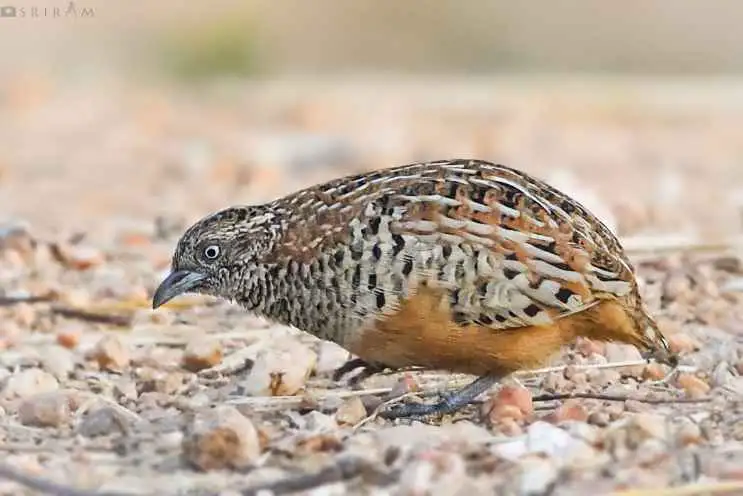
Barred Buttonquail
Tiny rotund, short-tailed bird, scarcely larger than a sparrow; like a diminutive partridge or quail but only distantly related. Brown with scaly streaking above, extensive black barring on the chest (more extensive on the female), and rich tawny flanks. Extremely difficult to detect, moving about invisibly in dense weedy vegetation in fields, forest edges, and farmland. Flying birds have whirring flight, show contrast between dark flight feathers and paler coverts. Courting females give sonorous, booming calls from dense vegetation.
Egyptian Vulture
Odd-looking, pale, medium-sized vulture with a bare, solemn-looking yellow face. The bill is narrow with a black tip. In flight, the deep-fingered black flight feathers contrasting with white inner feathers may recall White Stork, but the tail is wedge shaped. Juveniles are dirty brown with bare gray faces. An inhabitant of open or semiopen areas, nesting on cliffs and less frequently in trees. Scavenges at rubbish dumps in addition to carcasses, but sadly is in decline over much of its wide range.
Short-toed Snake-Eagle
Large, slightly ungainly raptor with long and very broad wings, a shortish tail, and a conspicuously big head. Pale belly and underwings contrast with the darker head in most adults, but juveniles have pale heads. All age groups have a tendency to look a bit disheveled. On perched birds look for the owl-like face and unfeathered legs. Hunts over open areas, spending lots of time hovering with rowing wingbeats into the wind.
Tawny Eagle
A medium-large, highly variable eagle that can range in overall color from whitish or creamy dull rufous to grayish-brown, and rarely dark brown. It has a moderately long gape line that stops at the center of the eye and slit-shaped nostrils. Legs are short and heavily feathered, with baggy “trousers.” Juveniles are generally paler than adults, while older immatures can have a dark hood and pale body. Mostly a bird of plains and open scrub; rarely seen over water, and avoids forests. Overall not as heavy looking as the Steppe Eagle, and never has a rich brown color tone.
Bonelli's Eagle
Medium-sized, athletically proportioned eagle, with streaked whitish underparts contrasting with dark wings and tail. Juveniles are rufous below, and lack the adult’s broad dark band at the tip of the tail. Found in forests or mountains, sometimes in more open habitats in winter; usually in remote areas. Builds nests on cliffs and ledges, and in caves. Distinctive in flight: note bulging secondaries and narrowness of wing where it meets the body. Usually seen soaring over distant ridgelines, when the shallow “fingers” to its wings are obvious in contrast to the deep fingers of other eagles.
Indian Roller
A brightly colored bird with various shades of blue on the wings, tails, and belly that are often more prominent in flight. Note the longitudinal white streaks on the throat and breast. Indochinese Roller has a purple-blue breast, a darker olive back, and is generally darker blue. Generally silent, but more vocal in breeding season with harsh calls. Prefers open areas, including agricultural landscapes, sitting on exposed perches including electric wires, occasionally pumping its tail slowly. Practically a resident roller with some movements in the western parts of its range.
White-naped Woodpecker
Uncommon, four-toed, large-billed, golden-backed woodpecker. Endemic to the Indian Subcontinent. Associated with open wooded habitat all over its range, but often difficult to find. Separated from the group of “small-billed” flamebacks by its much larger bill, a conspicuous white nape with a contrasting black border, and a divided black horizontal stripe below the cheek. Separated from the similarly large-billed Greater Flameback by its black rump, clean white nape, and preference for drier habitat. Often detected by its uniform trill.
Black Drongo
An adaptable songbird of open areas such as farmland, forest edge, meadows, wetlands, and fields and a common sight as a familiar dark silhouette perched on wires, fences, or snags. Black plumage flashes blue and green iridescence in favorable light, though much less so than in Hair-crested or Bronzed Drongo. A pugnacious species, frequently chasing away larger birds with repeated dives and harsh chattering calls. A skilled mimic of other species, and a strong songster in general, delivering a wide range of pleasant fluty calls, harsh chattering, nasal notes, and high sharp whistles.
Bay-backed Shrike
Brightly-colored small shrike, reminiscent of Long-tailed Shrike in overall coloration. Black mask, rufous flanks and back, clean white throat, and small size make it distinctive within its range. Prefers open areas, often in dry regions, with scattered vegetation. Often perches up on exposed snags, fenceposts, or telephone lines. Song is a messy jumble of musical warbles, harsh churrs, and sharp twanging notes. Calls include a harsh “jhiir.”
Rufous-tailed Lark
A plain, relatively well-proportioned lark which is brownish above and rufous below, with streaks on the breast. The bill is conical and heavy, and the long wings impart a slender appearance. Inhabits open areas with scrub and rocky landscapes. Often solitary or in pairs, foraging busily on the ground and often perching on high mounds or on wires. The pleasant song consists of short whistles and liquid trilling notes.
Yellow-throated Bulbul
Plain, pale brownish bulbul. Endemic to very specialized habitat in South India. Only found in hills with dry rocky scrub and boulders, co-occurring locally with the more widespread White-browed Bulbul throughout its range. Although both species have a yellow vent and can sound similar, Yellow-throated can be distinguished by its yellow head that contrasts with its whitish underparts. Usually occurring in pairs, it tends to rove along regular circuits, often perching on exposed rocks and boulders. Voice like White-browed’s, but more melodious and higher in pitch.
Lesser Whitethroat
Small brownish-gray warbler with a grayer head and broad dark mask that sets off the white throat. Lacks bright rusty wing patch of Greater Whitethroat. Varies subtly across wide range. Found in scrubby habitats, especially dense hedges with thorny bushes and trees. Skulking and difficult to see well; often located by scratchy chortling song that ends with a distinctive loud rattle. Gives dry ticking calls.
Yellow-eyed Babbler
An odd-looking babbler which looks and behaves like a prinia on steroids. Brown above and white below with rufous wingtips. Red eyering is unique. Scrambles about in reedbeds, scrub, field edges, and grassy meadows in small flocks and pairs. Scales stems like a parrotbill and hangs acrobatically like a tit or leaf warbler. Strident, melodic song has a somewhat hoarse, nasal quality. Calls include repeated descending whistles, energetic chattering, and dry chittering.
Indian Silverbill
Small, long-tailed finch with a chunky body and short, stout bill. Gray-brown above and pale below with a whitish rump and black-pointed tail. Highly sociable throughout the year. Found in semidesert, scrub, and dry woodland but also proliferates in urban areas. Distribution is centered on the Indian subcontinent, but it is a popular cage bird and feral populations are widespread. Gives sharp “tsik” and “tseet” calls.
Red Avadavat
Strikingly pretty small finch. Males are largely red and covered in white spots with dark wings and tail. Females are gray with a rufous rump. Both sexes have a red beak. Gives a very musical song a high "teei" call. Found in grassy areas close to water and often near human habitation, particularly areas with wet rice paddies.

