



No Habitat Specialisation
 Birds of Telangana
 No Habitat Specialisation

“No habitat specialisation” applies to generalist species that use a wide range of habitats rather than depending on a single type, allowing them to adapt to disturbed or human‑modified landscapes and remain relatively widespread and resilient.


Indian Peafowl
An unmistakable, large ground bird. The unmistakable iridescent blue male spreads out its ornamental upper tail feathers when courting females. Females have a shorter tail, an iridescent green neck, and browner plumage. Found in forest, forest edge, and agricultural land. Often seen on paths or alertly feeding in the undergrowth. Can be fairly confiding especially when found close to human habitation. Its loud screaming “may-yow” calls are heard incessantly during the rainy season.


Rock Pigeon
An unmistakable, large ground bird. The unmistakable iridescent blue male spreads out its ornamental upper tail feathers when courting females. Females have a shorter tail, an iridescent green neck, and browner plumage. Found in forest, forest edge, and agricultural land. Often seen on paths or alertly feeding in the undergrowth. Can be fairly confiding especially when found close to human habitation. Its loud screaming “may-yow” calls are heard incessantly during the rainy season.
Eurasian Collared-Dove
Large pale dove with a black crescent on the nape. Slightly smaller and paler than Rock Pigeon, with a proportionately longer, square-tipped tail. Favors farms and suburbs; avoids areas with extensive forests. Typically seen in pairs or small loose groups; forms larger flocks in winter. Widespread and common throughout much of Eurasia and northern Africa. Introduced to, and established in, much of North America, the Caribbean, and parts of Central America. Compare with African Collared-Dove, which may occur in small feral populations or as an escapee throughout Eurasian Collared-Dove’s range. Especially note tail pattern from below: mostly white, contrasting with the grayish undertail coverts, and with black extending down the outer edge of the tail feathers. Voice - a cooing “woop-WOOO!-woop” - is also helpful.
Red Collared-Dove
Medium-sized dove of open spaces with trees and bushes. Male is red with a bluish-gray head and female is brown overall. Both sexes have a dark collar. Female may be confused with other collared-doves, but is smaller with a shorter tail. Often forages in pairs, but may congregate in large flocks, particularly in agricultural fields where seeds have been spilled. Song is a hoarse and muffled-sounding series of three or four hoots.
Spotted Dove
A common garden bird throughout much of Asia, found in open forests, fields, and parks; introduced to several regions around the world. Often tame and approachable. Brown overall with a rosy breast and a unique white-spotted black nape patch. Plumage shows slight regional variation: western birds have dark centers to wing feathers, lacking in eastern birds. Turtle-doves are larger, have black centers to wing feathers and stripes rather than spots on the neck. Coos loudly and often: “coo-a-roooo”.
Laughing Dove
Small, similar in size to European Turtle-Dove. Tail is strikingly long with white corners and a grey center, but is all white underneath. Its body is pastel shades of brown and pink with a spotted black collar. Usually associated with human-modified landscapes, such as plantations, gardens, and urban areas as long as some trees are present. The call is a repetitious “coo- coo coo ru” replicated 5–8 times.
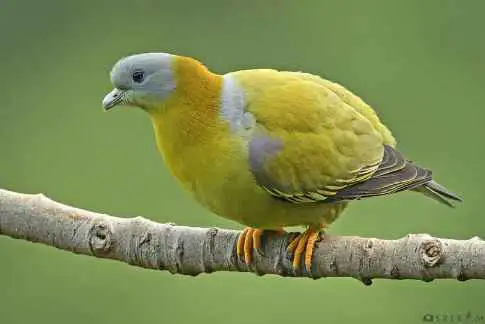
Yellow-footed Green-Pigeon
Brightly-colored pigeon with significant regional variation. Look for a gray “shoulder strap” and yellow legs. South Asian birds are the brightest, with an orange-yellow neck and green underparts. Southeast Asian birds have more extensive gray on the underparts. Sexes are similar. Found in lowland forest and forest edge, as well as parks, gardens, and orchards; a common urban bird in much of its South Asian range. Not extremely vocal; occasionally gives cooing whistles.
Greater Coucal
A large bird that resembles a cross between a crow and a pheasant. Largely black with distinctive rusty wings, glossy underparts, a long and heavy black tail, and deep red eyes. Juveniles are much duller with white bars on the tail and underparts and variable amounts of black streaks on the wings and upperparts. Common across a range of habitats except very dense forests. Similar to Lesser Coucal, but Greater Coucal is larger with a longer bill and red eyes. Adult Greater Coucals also lack the white streaks on the wings seen on Lesser Coucal. The call is a series of deep, resonant “oop-oop-oop” notes.
Pied Cuckoo
Black-and-white cuckoo with a spiffy crest (also known as the “Jacobin Cuckoo” for its smartly attired appearance). Some southern African birds exhibit a dark morph: all black with a white wing patch. Found in lowland and foothill open forests and plains, often in thorny growth. Song is a widely-spaced series of somewhat hoarse whistled notes. Lays its eggs in the nests of babblers, bulbuls, and shrikes.
Grey-bellied Cuckoo
Rather small cuckoo of open forests and forest edge. Typical adult is gray all over. Some females are “hepatic” and are ginger-orangish with black barring on the back and on the undersides. Song is a high, fading “ki-keeeer...” often given either very early or very late in the day. Breeds in foothill and montane forests, but migratory individuals typically winter in lowlands.
Red-wattled Lapwing
A distinctly marked lapwing with a black breast and throat and a red bill with a black tip. It also sports red wattles in front of the eyes and a white patch that runs down the cheeks to the underparts. In flight, note the black flight feathers that contrast with the white wing patch. Usually found in small groups around water bodies, agricultural fields, and dry land. They feed primarily on insects, catching them in a typical plover like manner, running a short distance and picking up food from ground. A bird known for its characteristics loud alarm call, often compared to the words “Did we do it?”
Red-naped Ibis
A medium-sized ibis with a dark body, often showing a bluish-green sheen. The crown and nape are covered in bright red warts. A white patch is usually visible near the shoulder of the wing. The bill is long and downcurved. This species can be confused with the similar-looking Glossy Ibis, but Glossy Ibis is smaller and lacks the red warts and white shoulder patch. In flight, the legs of Red-naped Ibis don’t extend beyond the tail, unlike in Glossy Ibis. Unlike most other ibis, Red-naped favors drier habitats, such as rye fields. It is usually found singly or in loose groups.
White-eyed Buzzard
A slim brown buzzard with a distinct white iris. Adults have a white throat with a prominent dark stripe, yellow base of the bill, and rufous tail. Dark tips to wing feathers are clearly visible in flight. Often shows a white patch on its nape. Juveniles have a buffy head and brown iris. The usual habitat is dry, open country or forest, where it mainly feed on insects, rodents, and small mammals. This species is most often seen soaring alone in thermals or perched still. Groups of two or three may sometimes be seen. The most commonly heard call is a plaintive mewing note or falling whistle.
Shikra
A common, widespread resident across Asia and Africa. Adult males have a reddish iris, blue gray upperparts and fine brownish-orange barring on underparts. Females have a yellowish iris and brownish gray upperparts. Both have narrow dark barring on the tail. Juveniles are browner with a prominent moustachial stripe and streaked underparts. It hunts for a wide variety of prey in woodland, savannah, and even suburban gardens, dashing out from perches within vegetation to grab its prey.
Black Kite
Medium-sized, rather nondescript raptor with overall dark plumage. Varies considerably across range, but always note tail fork (can disappear when tail is fully open), and short head and neck. Juvenile averages paler and more contrastingly-marked. Flight style buoyant, gliding and changing direction with ease. Frequently forages in urban areas, rubbish dumps, aquatic habitats, and grassland, but usually avoids heavily forested areas. Sometimes solitary, but also gathers in large flocks on migration and at good feeding areas.
Asian Barn Owl
Medium-sized owl with a heart-shaped facial disc and deep dark eyes. Varies somewhat across a wide range, but always note white-and-black speckling on the upperparts, beautiful gray-and-tawny wings, and large round head with ghostly white facial disc. Compared with various other masked-owls and grass-owls that overlap in range, Eastern Barn generally has a brighter white face. Hunts in open areas by night, foraging with a slow and buoyant flight. Roosts in old buildings, tree hollows, caves, and nest boxes by day. Gives a bone-chilling, rising shriek, as well as shorter rasping calls.
Rock Eagle-Owl
Large brown “horned owl” of rocky hills and semi-desert, as well as thorn scrub and groves in arid areas. Very similar in appearance to Eurasian Eagle-Owl, but note weaker streaking on the underparts and smaller size; range overlap is limited. Hoot is higher-pitched than that of Eurasian Eagle-Owl, a sonorous “bou-woo.”
Brown Fish-owl
Huge bulky brown owl with a finely streaked breast, a plain face, and bright yellow eyes. Also note its dirty white “bib” and the heavy brow that gives it a moody demeanor. Inhabits waterside wooded areas from lowlands up into the mountains; feeds by dropping down into and wading around in creeks, lakes, and pools. Often gives deep echoing hoots, as well as various shrieks and higher-pitched hoots.
Spotted Owlet
A small uncrested owl with a round head and a short tail. It is grayish-brown overall with white spots above while its underparts are white with brown bars. Note the distinctive white eyebrows and neck-band. Often active at dawn and dusk when it utters a loud “chirurr-chirurr-chirurr” laugh in addition to a variety of high-pitched squeals and whistles. Inhabits all kinds of open habitats but avoids dense forest and wetter regions.
Indian Grey Hornbill
A small, grayish-brown hornbill with a pale brow, an obvious casque above the bill (larger in males), and a dual-toned black-and-yellow bill. In flight, note the pale edges on the wings and tail, as well as long central tail feathers. When flying, beats its wings rapidly followed by a short glide. Prefers open woodlands, plantations, gardens, and parks in cities where it feeds on large, fruiting trees. Usually seen in pairs or small groups. The calls include a series of short “kek-kek-kek” notes given in flight and a squealing, hawklike high-pitched “kieeeeu” when perched.
White-throated Kingfisher
Large-headed, predominantly brown kingfisher with electric-blue back and wings, heavy red bill, and snow-white patch from the throat through the breast. Common both near and away from water; frequently seen perched on fence posts and telephone lines near wetlands, lakes, agricultural fields, and clearings. Gives jarring, raptor-like descending trills and cackles, often in flight.
Asian Green Bee-eater
A small, dainty bee-eater of open woodlands, farmland, and sparse human habitation. Mainly green with a bluish throat, slender black eye mask and throat band, rufous or slightly rusty crown and back of the neck, and central tail streamers. Juveniles are duller than adults and lack the long tail feathers. In flight, note the rusty underwing with a black trailing edge. Flies gracefully as it catches insects and other prey. Calls are a series of gentle liquid trills or more staccato notes.
Eurasian Wryneck
Bizarre and unmistakable small gray woodpecker. Note broad black stripe down middle of crown and back. Cryptic plumage and sluggish habits make it easily overlooked. Favors open country with scattered trees, orchards, farmland; nests in tree cavities. Feeds mostly on the ground, probing with its long tongue for ants; hops with deliberate, rather jerky motions, often twitching its tail and turning its head. Song is a rising series of high, piercing notes, similar to that of a falcon.
Black-rumped Flameback
A common, “small-billed” golden-backed woodpecker with four toes. Endemic to the Indian subcontinent and Sri Lanka. Associated with every lowland wooded habitat except dense tropical forest, it often follows degradation into higher elevations. Separated from all other flamebacks except Red-backed by dark throat, lack of a contrasting black horizontal stripe below the cheek, and four toes. Separated from Red-backed by golden back and black shoulder. Often detected by its loud “ki-ki-ki-ki-ki,” which steadily increases in pace and ends in a trill.
Eurasian Kestrel
Small falcon with distinctive male plumage: gray head, rusty back, gray tail with broad black tip. Female is brownish above, with barring on the back, wings, and tail. Note rather pointed wingtips (unlike rounded wings of Accipiter hawks), and distinct dark spotting on the breast. Inhabits open and lightly wooded country, farmlands, grasslands, and heathlands; often seen over grassy areas beside roads and at airports. Perches on wires and posts, and typically hunts by hovering, at times fairly high overhead. Very similar to Lesser Kestrel.
Peregrine Falcon
Sleek, fast-flying large falcon. Always look for a grayish back in adults, long wings that almost reach the tail tip, and powerful but slender build. Dark mark below each eye varies in shape and size. Juveniles are more heavily patterned below than adults, and can be quite brownish above. Patterning varies considerably across a wide global range, with back color ranging from pale gray in Central Asian “Red-capped” to slaty-blue across much of northern Eurasia North America, to almost black in Asian “Shaheen.” Chases prey down at high speeds with continuous powerful wingbeats. Becoming increasingly common in parts of range, especially in cities, where they can nest on tall buildings and feed on pigeons. Adaptable, and can be seen in a wide range of habitats; often encountered in areas with steep cliffs, as well as around coastal mudflats and open areas with shorebirds.
Rose-ringed Parakeet
Vibrantly bright green parakeet, frequently found in woodland, parks, and gardens, where it feeds mainly in trees. Nests in cavities, including holes in buildings. Easily overlooked if quiet, as the bright green plumage blends easily with foliage. Note the very long slender tail and bright red bill; male has narrow black-and-pink neck ring. Closely resembles the larger Alexandrine Parakeet, which has a wine-red patch on each shoulder. Like other parakeets, raucous and social, often appearing in noisy groups giving sharp screeching calls. Native to Africa and South Asia, introduced locally around the world, from Europe and the Caribbean to Japan and Hawaii.

