



Grassland Birds
 Birds of Telangana
 Grassland Birds

Grassland birds are species that depend on open grassy habitats with few trees or shrubs, using these areas for nesting, feeding, and displaying, and are sensitive to loss or fragmentation of natural grasslands


Grey Francolin
A small gamebird with an orangish face and fine barring throughout. Males and females are similar. Occurs in open grassy areas such as dry grasslands, scrub, and agricultural land. Often found in groups. Call, sometimes given simultaneously by several birds, is a loud repetitive “kateetar-kateetar”. Native to South Asia; introduced to Hawaii where it is common in dry areas on all Hawaiian islands.


Painted Francolin
Boldly patterned francolin with conspicuous white spotting on the underparts and upperparts. Endemic to peninsular India and Sri Lanka, but recently has not been recorded in most of south India. Occurs in cultivated and open habitat with scattered trees and dense undergrowth where it remains hidden most of the year. Commonly detected in the late summer and monsoon by its repeated, grating, and high-pitched “click—khrak-khrukuk—khrakakak” calls. Territorial males are occasionally seen calling from raised open perches including treetops. Calls nearly identical to Black Francolin.
Rain Quail
Streaky, small football-shaped bird, most often seen in flight as it flushes from almost underfoot. Male unmistakable, with natty black-and-white face pattern and triangular black splotch on the chest that resembles spilled paint. Female very similar to Common and Japanese Quails, distinguished by range and by proximity to a male. Inhabits grassy, open areas such as farmland, meadows, and grasslands. Disperses after breeding, occasionally to higher elevations. Male’s song is an odd, songbird-like pair of repeated high squeaks.
Chestnut-bellied Sandgrouse
A large, plump, and dovelike bird with a pointed tail. Males are sandy brown with a thin black breast band and solid chestnut belly. Females are sandy brown with black bars on the back and a mottled neck. Flight is fast and direct; often seen in flocks. Inhabits semidesert, dry plains, and sparsely vegetated scrubby areas. Gives noisy burbling calls. Native to Asia and Africa; introduced to northwestern Hawaii Island.
Yellow-wattled Lapwing
Elegantly long-winged brown lapwing. Breeding adult has clean black cap, bright yellow facial wattles, and a white belly. Non-breeding adults and juveniles are more mottled overall and lack a solid black cap. Note contrasting wing and tail pattern when in flight. Prefers dry open areas, often well away from water. Gives a loud rasping tern-like call and a loud “cheeeee’it” in alarm; generally not as noisy as other lapwings.
Indian Courser
Elegant and stately large plover-like bird. Note typically erect posture, strong black-and-white brow pattern, orange-suffused crown and chest, and slightly downcurved dark bill. Cream-colored Courser is much paler and more uniformly colored. Indian Courser inhabits dry open spaces, including rocky plains and arid areas with scattered scrubs. Gathers in small flocks outside of the breeding season.
Black-winged Kite
Small and distinctive falconlike kite. Light underneath, blue-gray above with conspicuous black shoulders formed by black wing coverts. Juveniles have a scaly back and brownish-washed breast. Found in open savannah, semi-desert, and agricultural lands with scattered woods; frequently seen on exposed perches. Varied flight style, hovering like a kestrel or gliding like a harrier with deep wingbeats and raised wings.
Pallid Harrier
Males are ghostly gray above with black wingtip wedges. Females are more difficult to separate from other harriers; pay attention to the underwings with their barred primaries and dark secondaries. Juveniles are rufous and similar to Montagu’s, but appear dark rather than pale faced. In flight, a bit bulkier than Montagu’s but much more buoyant than Hen Harrier. Found in steppes, wet grassland, agricultural areas and other open spaces. Sometimes forms flocks outside of the breeding season, occasionally mixing with other harrier species.
Montagu's Harrier
Lightly built hawk with rather narrow and somewhat tapered wings. Favors heathland, grassland, arable fields, marshes. Mainly seen in flight, quartering fairly low with wings raised in shallow V; flight rather buoyant. Male pale gray overall with black wingtips (can be confused with a gull); note narrow black bar on upperwing. Female told from Hen Harrier by narrower wings, more buoyant flight; juvenile bright rusty below. Some individuals are very dark overall. Pallid Harrier males lack the black wing bars and rusty traces on the underparts of their Montagu's counterparts, while Pallid females and juveniles average far paler in the face.
Eurasian Hoopoe
Utterly unmistakable orange bird with a zebra-striped wings, a Chinese fan of a crest (usually held closed, but often raised just after landing), and a rapier of a bill. Favors semiopen habitats such as heathland, farmland, orchards, grassy lawns, where it feeds on the ground, probing with its long bill for insects. Flight fast and fairly direct, with rather deep wingbeats. Unlikely to be confused, but flight pattern and round wings may loosely resemble that of woodpeckers; note far longer and thinner bill. Song is a distinctive “hoopoopoo.”
Red-necked Falcon
A rather small but powerful falcon with fast and direct flight. It has a rufous crown, nape, and moustachial stripe. A wide yellow eye-ring is quite distinct. Its upperparts are pale gray, and fine barring adorns its white underparts, which are sometimes suffused with gray. This bird of the open country mostly hunts birds on the wing, targeting its prey from a perch, often bringing it down quite close to the ground.
Ashy-crowned Sparrow-Lark
A small, stocky bird with a heavy, finch-like bill. Males have a gray head that contrasts with a black eye-stripe, and black on the collar, throat, and underparts. Females are pale brown with weak streaks on the head, back, and underparts. Similar to Black-crowned Sparrow-Lark, but Ashy-crowned males are told apart by the gray on the head. Females are difficult to distinguish. Inhabits dry scrub, fields, and rocky country. The song is often given in display flight, and consists of monotone whistles interspersed with buzzy notes.
Zitting Cisticola
Very small, with a distinctive short, rounded tail with conspicuous spots at the tip. Body sandy-colored below, streaky above. Breeding males have a dark bill and crown. Found in open grasslands, meadows, marshes, and agricultural areas. Most readily detected by its repetitive and monotonous song, given from either a perch or in an undulating song flight. Song varies across wide distribution, ranging from evenly-paced squeaky “tsik, tsik” of African and European birds to the fast dry ticking of Southeast Asian birds.
Tricolored Munia
Small, finchlike bird of weedy and grassy areas in tropical lowlands. Often in small flocks, which associate readily with seedeaters and grassquits. Adult is handsome and striking with rusty upperparts. Black head and underparts are cut by a broad white swath from flanks across the lower breast. Note stout gray bill. Juvenile notably plain, buffy brown overall with stout bluish-gray bill. Note the pointed tail, unlike seedeaters and grassquits. Native to Asia and spreading in New World as an escaped cage bird.
Paddyfield Pipit
A sparrow-sized, resident pipit with brown plumage that varies in tones in different parts of its range. All birds have a bi-colored bill with a curve to the tip of the upper bill. The breast is streaked and the upperparts have variable amounts of streaking. Juveniles show distinct and dark mottling on the upperparts. It is common in open habitats such as wetlands, farms, fields, and even large parks. Very similar to Blyth’s and Richard’s Pipits, but relatively compact and has a more distinct eyebrow, fainter or no streaking on the back of the neck, a larger head, and a shorter tail than either Blyth’s or Richard’s. Calls include short “tsip” and “tissip” notes.
Black-headed Bunting
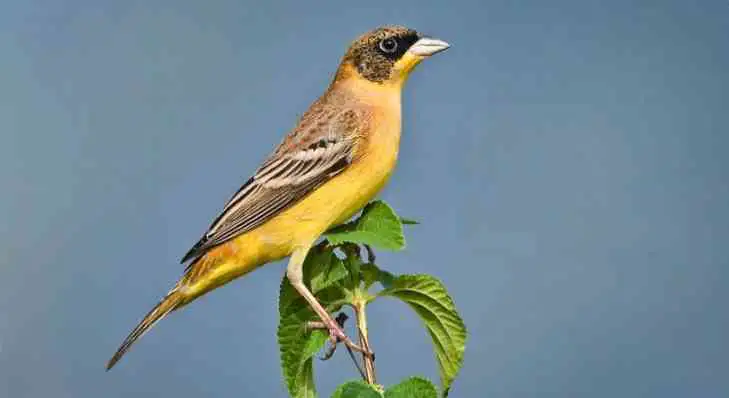
Large, stocky bunting. On breeding males, the combination of a black head, a bright yellow collar, yellow underparts, and rusty-brown back is unmistakable. The black on the face of nonbreeding males is restricted to the patch around the eyes forming a “bandit’s mask.” Female is plain brown overall with a pale yellowish wash on the vent and traces of yellow on the rump. Extremely similar to female Red-headed Bunting; best to use a combination of various details to separate the two, with the Red-headed Bunting having a yellower rump and belly, a more noticeably streaked crown, and a bulkier bill than Black-headed Bunting. Breeds in open forests, edges, and patchily planted areas like orchards and gardens. Winters in farmland. Song is a rather lacklustre series of buzzy notes. Calls are varied and include sparrowlike chirps and high thin “tseep’s.”
Red-headed Bunting
Large, stocky bunting with a long tail. Rusty-red head and yellow body easily identify the breeding male; non-breeding male has restricted red on the head and a streaky brown back. Female and juvenile are pale brown with streaked back and wings; these plumages can be nearly impossible to separate from Black-headed Bunting. Look out for Red-headed’s less extensive crown streaking, less “compact” appearance (longer-billed and longer-tailed), less yellow underparts, and colder back coloration. Breeds in open dry spaces with scattered bushes; winters in agricultural fields. Song starts out with a few dry, rasping notes, then turns into a more fluid-sounding jumble.

