

Diplomatic Dispatch
 GeoPulse
 Diplomatic Dispatch

We decode global diplomacy through key treaties, negotiations, diplomatic shifts, and conflict-resolution efforts, offering clear insights into the decisions and developments shaping international relations.


Tariffs and the Reordering of Trade: The Trump Administration's Tariff War, 2025–2026
Beginning January 20, 2025, the Trump administration pursued the most sweeping US tariff escalation in decades, invoking emergency powers (IEEPA) to impose a baseline 10% tariff on nearly all imports, "reciprocal" country-specific rates of 10–50%, and sector-specific Section 232 duties on steel, aluminum, autos, copper, and other goods. The centerpiece was the April 2, 2025 "Liberation Day" order. On February 20, 2026, the Supreme Court ruled 6–3 in Learning Resources v. Trump that IEEPA does not authorize tariffs, invalidating the reciprocal-tariff regime; the administration immediately shifted to Section 122 (a temporary, 150-day authority) and Section 232/301 tools instead.
Global Impacts on the World Order
The tariffs strained the WTO's most-favored-nation principle, as the US applied differentiated, negotiated rates rather than uniform ones—prompting a bloc of WTO members (including several African states) to pledge collective defense of the multilateral system. Trading partners largely avoided full-scale retaliation, instead negotiating bilateral "framework agreements" (with the EU, Japan, UK, Vietnam, Indonesia, and others) combining tariff ceilings with investment and purchase pledges. Supply chains accelerated diversification away from China toward Vietnam, India, and Mexico, while China leveraged rare-earth export controls as counter-leverage. The Supreme Court ruling and Congress's temporary AGOA extension underscored how much of the "tariff war" rested on contested, shifting legal authority rather than settled policy.
China
Washington and Beijing escalated tariffs to peaks near 145% (US) alongside reciprocal Chinese duties on agriculture in 2025, plus Chinese export controls on rare earths, gallium, and germanium. A Trump-Xi meeting in Busan (October 2025) produced a one-year truce: China suspended its October 9 rare-earth controls and agreed to purchase at least 12 million metric tons of US soybeans in late 2025 and 25 million tons annually through 2028, while the US cut tariffs to roughly 47% and halved fentanyl-related duties. Analysts were divided on who gained more—some strategists argued China "got the better" of the deal by using rare earths and soybeans as leverage, while the White House framed it as a major concession from Beijing. A further deal in May 2026 added agricultural purchase pledges. The relationship remains a tactical truce rather than a structural resolution, with technology and Taiwan tensions unresolved.
European Union
After threatening a 30% tariff, the US and EU reached a framework (July 27, finalized August 21, 2025) setting a 15% all-inclusive ceiling tariff on most EU exports, including autos (down from 27.5%), pharmaceuticals, and semiconductors. In exchange, the EU committed to eliminating tariffs on US industrial goods, opening agricultural market access, and to $600 billion in investment plus $750 billion in energy purchases. The deal averted an acute rupture between the world's two largest trade blocs but left friction over EU digital and tech regulation, with Brussels retaining its Anti-Coercion Instrument as a deterrent. EU implementation, requiring European Parliament and Council approval, extended into mid-2026.
India
US-India relations deteriorated sharply after Washington imposed a 25% reciprocal tariff (August 2025) plus an additional 25% penalty tied to India's continued purchases of discounted Russian oil, bringing the total to 50%—the highest rate applied to any major US trading partner. New Delhi called the move "unjustified," refused to halt Russian oil imports, and pursued WTO consultations and export diversification while publicly resisting what officials described as "bullying." Tensions eased only after a February 2, 2026 deal cut the tariff to 18% in exchange for India committing to reduce Russian oil purchases and increase US imports. The Supreme Court's February 2026 IEEPA ruling further complicated enforcement of oil-related tariff conditions, giving India renewed room to maintain some Russian purchases. The episode strained a relationship Washington had cultivated as a counterweight to China, exposing limits to tariff leverage over strategic autonomy.
Africa and Latin America
Reciprocal tariffs effectively nullified preferences under the African Growth and Opportunity Act (AGOA), which lapsed on September 30, 2025, before Congress passed a one-year retroactive extension signed by Trump in February 2026. Analysts found AGOA-eligible exports to the US fell roughly 32% year-on-year by late 2025, with South African auto exports plunging nearly 75%; copper tariffs hit the Democratic Republic of Congo and Zambia, while steel/aluminum tariffs reached 50%. In response, several African states pursued diversification, including new Chinese zero-tariff access for 53 African countries from May 2026. In Latin America, Brazil was singled out with a 50% tariff (effective August 2025)—unusually justified partly by US objections to Brazilian judicial proceedings against former president Jair Bolsonaro rather than trade imbalances alone—prompting Brazilian criticism of tariffs as political interference, alongside continued negotiation over agricultural exemptions. Other regional economies, including Mexico, secured temporary truces tied to migration and drug-trafficking concerns rather than conventional trade disputes.
Conclusion
By mid-2026, the tariff war had reshaped US trade relationships through improvised, executive-driven bargaining rather than durable multilateral rules—yielding a patchwork of bilateral frameworks, temporary truces, and legally contested authorities. The Supreme Court's invalidation of IEEPA tariffs exposed the fragility of the legal basis underpinning much of the campaign, while the pivot to Section 122 and Section 301 tools signaled intent to sustain protectionist measures despite the ruling. Lasting effects include accelerated supply-chain diversification, weakened confidence in US commitments to preference programs like AGOA, deepened Chinese leverage via critical minerals, and a more transactional, leverage-based model of trade diplomacy that has strained but not severed key alliances.
Sources:
CRS, Presidential 2025 Tariff Actions: congress.gov/crs-product/R48549
White House Fact Sheet, US-China deal (Nov. 2025): whitehouse.gov/fact-sheets/2025/11/fact-sheet-president-donald-j-trump-strikes-deal-on-economic-and-trade-relations-with-china
European Commission, EU-US trade deal: commission.europa.eu/topics/trade/eu-us-trade-deal_en
Supreme Court, Learning Resources v. Trump (2026): supremecourt.gov/opinions/25pdf/24-1287_4gcj.pdf
CFR, India-US Relations and Russian Oil: cfr.org/articles/oil-energy-india-u-s-relations-and-the-russia-conundrum
ISS Africa, AGOA and US tariffs: issafrica.org/iss-today/agoa-changes-add-to-africa-s-rollercoaster-ride-of-us-tariffs
Atlantic Council, Trump Tariff Tracker: atlanticcouncil.org/programs/geoeconomics-center/trump-tariff-tracker


China's Belt and Road Initiative: Ambition, Interests, and the "Agenda" Debate
Launched by Xi Jinping in 2013, China's Belt and Road Initiative (BRI) is a global infrastructure program formalized in the 2015 "Vision and Actions" document. By 2021, China had signed BRI agreements with 145 countries. It is debated because its scale and opacity invite competing readings: development diplomacy, or strategic influence. This article argues BRI plausibly serves overlapping commercial, developmental, and strategic interests — but sensational "debt-trap" and "hidden takeover" claims are only partly supported, the record being more mixed and host-driven than one master narrative suggests.
Background
BRI spans transport, ports, energy, telecoms ("Digital Silk Road"), and green finance (overview). Financing comes mainly from Chinese policy banks and state contractors, with lesser multilateral participation via the AIIB and Silk Road Fund. Projects are usually negotiated via bilateral government MOUs, then commercial loan/construction contracts — a large, loosely coordinated portfolio, not one master plan (NBR Guide).
"Agenda" Claims and Their Limits
Stated objectives: Policy coordination, Connectivity, Trade facilitation, Financial integration, People-to-People ties.
Plausible inferred motives: Exporting excess industrial capacity, opening markets for Chinese firms, securing resource/energy routes, extending standards influence (analysis). Some ports have dual-use value; in Djibouti, BRI-adjacent financing coincided with China's first overseas military base.
Weakly supported allegations: That BRI is a coordinated "Debt-Trap" strategy to seize assets on default. Case research often finds this overstates intent, understates host-country agency and mismanagement.
Case Studies
Sri Lanka: Hambantota Port
Built 2008–2014 with Exim Bank loans, Hambantota underperformed commercially, feeding a debt crisis by 2015 (Britannica). In 2017, Sri Lanka Ports Authority leased a majority equity stake in the port's operating company to China Merchants Port Holdings for 99 years, for $1.12 billion (AidData). This was a lease/equity concession for port operations, not a debt-for-equity swap: original Exim Bank construction loans were not cancelled, and repayment shifted to the General Treasury rather than being forgiven (Diplomat). Sovereignty was not transferred, and the government barred Chinese military use (BBC). Interpretations diverge: some call it asymmetric leverage (CSIS); others, citing later commercial recovery, reject the "debt-trap" label (SCMP).
Djibouti
Exim Bank loans for port, rail, and pipeline projects pushed public debt from ~50% to over 85% of GDP within two years (IMF, 2017). Separately, Djibouti voluntarily agreed to host China's first overseas military base (2017) for lease payments (Jamestown). Debt remains in IMF-assessed distress, with a repayment moratorium through 2027; no forced transfer of port ownership occurred (IMF DSA 2025).
Montenegro: Bar–Boljare Highway
A roughly $1 billion Exim Bank loan financed the first stretch of a highway built by China Road and Bridge Corporation from 2014. Overruns and weak traffic forecasts pushed public debt above 100% of GDP (NPR). Rather than losing assets to China, Montenegro—an EU-candidate, NATO member—secured a 2021 Western refinancing (Goldman Sachs, Merrill Lynch, Societe Generale, Deutsche Bank), exited early in 2023 on favorable terms (RFE/RL). No equity or control passed to China; the outcome was a contested sovereign refinancing, not a takeover.
Assessment: Financial distress and Chinese leverage are well documented, but confirmed transfers of sovereign control are rare and narrow (concessions, not sovereignty), typically following extended negotiation, not unilateral seizure.
Responses by Major Economies
Western and allied governments have built explicit alternatives. The G7's Partnership for Global Infrastructure and Investment (PGII), launched 2022, aims to mobilize $600 billion by 2027, incorporating the EU's Global Gateway and Italy's Mattei Plan (G7 PGII 2024; ORF). Flagship projects include Africa's Lobito Corridor and the U.S.–Japan–Philippines Luzon Corridor (White House 2024).
Assessment: Funding committed vs. Delivered—disclosure lags; as of early 2024 "most of the details of the PGII had not yet emerged" (Wikipedia), and disclosed sums (e.g., ~$14.75 million for Lobito preparation) are small against the $600 billion target. Pipeline/speed—a handful of flagship corridors are active, but pace and coverage trail BRI's 145-country footprint. Governance—PGII/Global Gateway emphasize transparency and debt sustainability, a real differentiator on paper, though implementation evidence remains limited. Overall: credible, not yet matching BRI's scale or speed.
Conclusion
China's stated aims—connectivity, trade facilitation—are documented in official texts. Strategic byproducts, including market access, resource security, and occasional dual-use infrastructure, are plausible and, in Djibouti's case, directly evidenced. But the strongest "hidden agenda" claim—a deliberate, systematic debt-trap strategy for seizing sovereign assets—is not well supported: outcomes vary by country, driven largely by host-government choices and project economics, with control transfers limited to narrow commercial concessions. Uncertainty remains because BRI lacks one master strategy, financing terms are often opaque, and China's digital and military-basing ambitions are still unfolding. Sweeping claims either way—pure development or deliberate takeover—warrant caution; project-level evidence should guide judgment.
DRC's Copper and Cobalt Export Prohibition: Leveraging Critical Minerals in the Energy Transition
Context
The Democratic Republic of the Congo (DRC) supplies roughly 70–75% of the world's mined cobalt and ranks as Africa's largest, and the world's second-largest, copper producer. Mining drives close to half of DRC GDP. Yet the country has historically exported much of its cobalt as semi-processed hydroxide and copper as concentrate, with final refining concentrated abroad—especially in China. This gap between resource wealth and processing capacity has long frustrated Kinshasa.
The Prohibition: What It Is and Why
In late June 2026, DRC's mines, foreign trade, and economy ministers signed a joint order immediately banning exports of copper and cobalt concentrates, repealing a 2023 order that had allowed waivers. One-year strategic exemptions remain possible, and a new tax on significant mining by-products has a three-month transition period. Similar concentrate bans occurred in 2013, 2019, and 2023, each meant to push operators toward domestic smelting. This builds on a separate cobalt policy: an outright export suspension from February–October 2025 (after a price collapse), replaced by annual quotas capping cobalt exports near 96,600 tonnes for 2026–2027, with a strategic reserve held by regulator ARECOMS.
The DRC is explicitly seeking to leverage its position as top cobalt supplier and a major copper source to build domestic processing, raise tax and royalty revenue, and retain more value at home. Enforcement details and interaction with existing quotas remain evolving, and reporting on scope varies by source.
Global Supply-Chain Impacts
Impact hinges on how much material moves as raw concentrate versus refined product. Much Congolese copper already leaves as cathode, limiting the ban's immediate reach for majors with in-country smelters, such as Ivanhoe Mines' Kamoa-Kakula. Exposure is greater for operations still reliant on concentrate exports and exemptions.
For cobalt, quotas already cap exports near half of 2024 levels, tightening battery-grade supply for EVs, electronics, and grid storage. Refiners—concentrated in China—face feedstock bottlenecks and pressure to diversify toward alternatives such as Indonesian nickel-cobalt byproducts. On copper, the ban lands amid an already-stressed smelting market where treatment and refining charges have turned deeply negative, meaning smelters earn little to process ore; a further cut to concentrate could intensify competition for feedstock globally. Downstream, battery and cathode makers, automakers, and electronics manufacturers may face longer lead times and stronger incentive to qualify alternative suppliers or expand recycling of end-of-life batteries and scrap.
Global Economic Impacts
Markets reacted quickly: benchmark London Metal Exchange copper rose as much as 1.8% on the news, nearing its January 2026 record. Cobalt prices had already more than doubled through 2025 as the suspension and quotas tightened availability, reversing an oversupply-driven slump.
Key mechanisms: reduced exportable volumes; buyers drawing down or building stockpiles ahead of tighter supply; and renegotiated offtake contracts reflecting scarcity, quotas, or new taxes. Sustained tightness could add modest inflationary pressure to battery and EV costs, and to copper-dependent wiring, electronics, and construction. Investment may shift toward non-DRC projects (Chile, Peru, Zambia, Indonesia), DRC-based refining to secure waivers, and lower-cobalt battery chemistries. Trade flows may realign as the US pursues preferential access with Kinshasa while China, the dominant buyer of Congolese output, faces the most direct exposure.
Stakeholder Responses and Adaptation
Miners are responding unevenly: Glencore has backed quota-based predictability, while CMOC has opposed tighter restrictions constraining its expanded output. Firms with integrated local processing, like Ivanhoe's onsite smelter, are comparatively insulated. Refiners and battery makers are diversifying feedstock, expanding recycling, and in some cases accelerating substitution toward lower-cobalt chemistries such as LFP. Governments, notably the US and EU states, are pursuing strategic minerals partnerships with the DRC, while also backing alternative supply elsewhere. Analysts note the approach echoes Indonesia's nickel export restrictions, which forced smelting capacity onshore—suggesting other resource-rich nations may consider similar strategies for lithium and rare earths.
Conclusion
The DRC's copper and cobalt export prohibition, layered atop its evolving cobalt quota system, escalates a decade-long push toward resource nationalism aimed at capturing more value from its mineral wealth. Because much Congolese output already moves as refined product, the immediate supply-chain shock may be more contained than the price reaction suggests—but the direction is clear: Kinshasa intends to shape global terms of trade rather than simply supply raw material. Expect continued price volatility in battery and industrial metals, accelerated investment in alternative supply and processing, and growing pressure on manufacturers to diversify, recycle, and substitute. Given the pace of policy change, specific figures and enforcement details should be treated as subject to revision.
Sources
Reuters (via Business Day) — "DRC bans copper and cobalt concentrates exports" https://www.businessday.co.za/world/2026-08-06-drc-bans-copper-and-cobalt-concentrates-exports/
Reuters (via MINING.COM) — "Congo bans copper and cobalt concentrates exports, official order says" https://www.mining.com/web/congo-bans-copper-and-cobalt-concentrates-exports-official-order-says/
Reuters (via US News) — "Exclusive-Congo Bans Exports of Copper, Cobalt Concentrates, Official Order Says" https://www.usnews.com/news/world/articles/2026-08-06/exclusive-congo-bans-exports-of-copper-cobalt-concentrates-official-order-says
Africanews — "DR Congo: Government bans export of copper and cobalt concentrates" https://www.africanews.com/2026/08/06/dr-congo-government-bans-export-of-copper-and-cobalt-concentrates/
IEA Policies Database — "DRC ARECOMS Decision No. 004/2025 – Cobalt Quota System" https://www.iea.org/policies/29138-drc-arecoms-decision-no-0042025-cobalt-quota-system
Related Videos
DW Documentary — "The cost of renewable energy: Inside the DRC's perilous cobalt mines" https://www.youtube.com/watch?v=n3DTxggc9ig
Al Jazeera, The Listening Post — "The horror of cobalt mining in DR Congo" https://www.youtube.com/watch?v=eJdktQ97rZ8
DW News — "How cobalt mining became a disaster for Congolese communities" https://www.youtube.com/watch?v=OvKnn8BRRI8
Reuters — "Congo produces first 1,000 tons of traceable artisanal cobalt" https://www.youtube.com/watch?v=c7Cgz7Y44Dg
Firstpost Africa — "How Africa's Cobalt and Lithium Bans are Crushing China's EV Supply Chain" https://www.youtube.com/watch?v=UwHgGfkrHGA
Trump's 'Economic D-Day' Stops Short at China's Door
What "Economic D-Day" Actually Involves
On August 24, 2026, Treasury Secretary Scott Bessent rolled out what he and President Trump had branded an "economic D-Day," formally named Operation Economic Outcast. Treasury designated more than 60 entities tied to Iran's oil, shipping and financial networks, ordered Bank Melli Iran to shut down, and widened the categories of "Iran-related conduct" that could trigger secondary sanctions to cover digital assets, gold, aviation, technology and shipping. Bessent said countries doing business with Tehran would get "defined timelines" to cut ties, but the administration held back its biggest threat: sanctions on major foreign banks.
China sits at the center of this because it buys close to 90 percent of Iran's oil exports, by Treasury's own estimate, mostly through small independent "teapot" refineries in Shandong province. Those refiners stepped in after China's state majors pulled back from Iranian crude after the 2018 US withdrawal from the nuclear deal, giving Beijing what analysts call plausible deniability. Any campaign meant to cut Iran's revenue has to eventually confront that demand, or risk staying largely symbolic.
Has It Really "Hit a Chinese Wall"?
The phrase captures something real, though it overstates the case. On the real side: the sanctions hit Chinese and Hong Kong procurement, shipping and financial intermediaries, but stopped short of major state banks. Bloomberg noted that a campaign excluding China isn't likely to seriously affect Iran, and analysts told CBS News and Al Jazeera that a Trump-Xi summit planned for September 24 has made Washington reluctant to escalate against Beijing directly. China's Foreign Ministry has repeatedly called the sanctions "illegal," and in May 2026 China's Commerce Ministry invoked a blocking statute against US sanctions on five teapot refineries, voiding their effect domestically. That's about as literal a wall as sanctions policy gets.
Still, "wall" risks implying total imperviousness, which the evidence doesn't support. China's Iranian oil imports fell sharply in August 2026, from roughly 823,000 barrels a day in July to about 534,000, as a reinstated US naval blockade in the Gulf choked physical supply rather than financial sanctions doing the work. So far, the blockade and military pressure seem to have constrained flows more than the financial sanctions, which have mostly hit replaceable intermediaries rather than the banks that actually matter.
Beijing's Realistic Options
1. Diplomatic pushback: keep calling the sanctions illegitimate "long-arm jurisdiction." Low cost, but hasn't moved Washington before and leaves real exposure unchanged.
2. Legal countermeasures: expand blocking statutes and "unreliable entity" listings, as done in May 2026. Shields firms domestically but doesn't restore their dollar or US market access.
3. Currency shifts: deepen yuan-settled trade via the Cross-Border Interbank Payment System, which handled roughly 134 billion dollars daily in March 2026, a fraction of dollar-clearing volumes. Cuts exposure at the margins, not at scale.
4. Managed compliance and rotation: let teapot refiners absorb risk while state banks stay clean, rotating front companies as entities get designated. Keeps oil flowing cheaply, but raises long-term compliance and reputational costs.
5. Supply diversification: lean harder on Saudi, Iraqi, UAE and Russian crude, a shift already under way by mid-2026. Cuts single-supplier risk, at a price premium.
6. Leverage the summit: treat Iran as one thread in the broader trade relationship rather than let Treasury set terms unilaterally. Plausible, but ties Iran policy to unrelated frictions.
Risks and Wider Implications
The calibrated scope of the sanctions, hitting intermediaries while sparing banks, suggests Washington is treating Iran policy as one thread in a fragile, broader trade detente rather than a standalone security question. That limits near-term escalation, but it also means Iran sanctions could become a bargaining chip, a shift congressional critics have already flagged as a departure from stated policy. On energy security, China remains only partly insulated: it still draws more than half its crude from the Middle East, and August's import drop shows Iranian barrels can disappear quickly once the physical route closes, regardless of financial sanctions. For global markets, analysts warn a campaign seen as seriously targeting China could trigger retaliation and add volatility to oil and shipping markets already strained by the wider conflict. And for sanctions enforcement broadly, a genuine confrontation with Chinese banks carries its own systemic risk: pushing Beijing further toward non-dollar settlement could, over time, erode the dollar's centrality to the system that gives US sanctions their force. These remain analysts' assessments of a fast-moving situation, not settled conclusions.
Sources
U.S. Department of the Treasury, "Treasury Warns of Sanctions Risks Linked to China-Based Independent 'Teapot' Oil Refineries" —
https://home.treasury.gov/news/press-releases/sb0476
CBS News, "If the U.S. wants to end the war with Iran by way of economic sanctions, China is key" —
https://www.cbsnews.com/news/iran-war-us-sanctions-china/
Al Jazeera, "US threat of 'economic D-Day' for Iran tests Trump's China detente" —
https://www.aljazeera.com/economy/2026/8/24/us-threat-of-economic-d-day-for-iran-tests-trumps-china-detente
Related YouTube Videos
"FULL EVENT: Secretary Bessent Announces Economic D-Day on Iran & Allies – 08/24/26" —
https://www.youtube.com/watch?v=-8QQz6WcEGI
"China Fires Back at U.S. Sanctions — This Changes Everything" —
Russia Reportedly Helped Iran Develop Supersonic Cruise Missile Technology
What "Supersonic" Means for a Cruise Missile
A cruise missile that flies at supersonic speed travels faster than sound, roughly Mach 2 to Mach 3, for most or all of its flight, rather than moving at the subsonic pace common to most cruise missiles in service today. That speed typically comes from a ramjet, an engine that compresses incoming air using the missile's own forward motion instead of a rotating compressor. The military appeal isn't just raw speed: paired with a low flight path, a fast-moving missile gives air defenses far less time to detect, track, and intercept it before impact. This piece stays at that level of explanation and does not get into how such an engine is designed, built, or tuned.
What The Financial Times Reported
On September 2, 2026, the Financial Times published an investigation describing a multiyear, covert Russian effort to help Iran develop a ramjet-powered supersonic cruise missile under the codename "C430L." The FT said its findings were based on leaked correspondence, travel records, and military patents, covering a program that began in 2023 and continued into 2026. The report said the project was arranged by Rosoboronexport, Russia's state arms exporter, working with NPO Mashinostroyenia, a missile design bureau already under Western sanctions, and that Russian representatives traveled to Iran repeatedly before a contract with Iran's Ministry of Defense and Armed Forces Logistics was signed in November 2023. By 2025, those engineers were said to be reviewing Iranian flight-test data and advising Tehran on the propulsion system's fuel setup, combustion behavior, air intake, and engine nozzle. In April 2025, Rosoboronexport reportedly proposed sending roughly two dozen Russian specialists to Iran for further consultations, and the cooperation is said to have continued even after the 2026 US-Israeli war with Iran began. Notably, the FT reported that Iran has built and flight-tested the ramjet propulsion system, but found no evidence that a Russian-assisted supersonic cruise missile has actually been deployed. This is the finding of one news organization's investigation, not a confirmed government assessment, and it should be read that way.
Silence From Moscow and Tehran, a Wider Pattern of Cooperation
None of the parties named in the story have confirmed or denied its central claims. The Kremlin, Rosoboronexport, NPO Mashinostroyenia, and the Iranian government did not respond to the Financial Times' requests for comment, according to the newspaper. That silence sits within a broader, well-documented relationship: Russia and Iran signed a strategic partnership agreement in January 2025 covering closer military and defense ties. That pattern also includes Iran's separate, well-established supply of Shahed-type attack drones to Russia and help setting up their production inside the country, a transfer distinct from the missile-cooperation claims above. Because no government has publicly corroborated C430L on the record, its existence and scope currently rest on the FT's sourcing, not confirmed intelligence findings.
What Experts Say It Would Mean
Analysts cited by the FT treat the alleged transfer as significant if accurate, while stopping short of calling it operational. Fabian Hinz, a missile analyst at Conflict Armament Research, described it as the transfer of "highly strategically sensitive military technology" that Iran has sought for decades, adding that a program of this kind would need political approval from the top of the Russian government. Jim Lamson, a former CIA analyst focused on Iran now at the James Martin Center for Nonproliferation Studies, said that if Russia helps Iran resolve its remaining technical problems, it would rank among the more consequential instances of Russian military-technical support to Iran in recent years. Hinz separately noted that experienced engineering know-how, a specialist who can troubleshoot in person, can matter more than blueprints or components, and that the program reportedly remained active into 2026, with both sides discussing a further phase as recently as June, though it's unclear whether that next stage formally began. None of this confirms such a weapon exists in Iran's arsenal today. It describes an alleged technology-transfer effort whose outcome, based on public reporting so far, remains unresolved.
Related YouTube Videos
WION — "Report: Russia Helping Iran Develop Supersonic Cruise Missile" —
https://www.youtube.com/watch?v=6Pj-IrGiws0
Firstpost — "Putin's Secret Iran Missile: Trump's Warships In The Crosshairs?" —
https://www.youtube.com/watch?v=6KI_hEPBa-0
India Global Review (The Palki Sharma Show) — "Russia Helping Iran Sink U.S. Warships?" —
Rupee-Ruble Trade in Practice: How India-Russia Settlement Works Under Sanctions Pressure
What "local currency trade" means here
In this corridor it means invoicing and settling in rupees or rubles instead of dollars or euros. It took shape after 2022, when sanctions cut major Russian banks off from SWIFT. The RBI's July 2022 framework lets Indian banks hold Special Rupee Vostro Accounts (SRVAs) for foreign correspondents. Sberbank's India head says about 96% of bilateral trade now runs through rupee-ruble channels, though that's a company claim and some payments still move in dirhams or yuan.
How a typical transaction works
The contract names a currency, usually INR. The Indian importer pays rupees into the SRVA that an Indian bank keeps for a Russian bank (a vostro for the Indian bank, a nostro for the Russian one). Indian exporters are paid from the same balances. With no deep INR-RUB market, conversion has often gone through a third currency, which adds spreads. Paperwork includes the invoice, bill of lading and often a letter of credit under UCP rules, plus extra KYC and sanctions screening.
Settlement, repatriation and frictions
India buys far more than it sells (roughly $61 billion of imports against $4 billion of exports in FY2022-23), so rupees pile up in Russian accounts. The rupee is only partly convertible and has few uses abroad. The RBI now lets surplus balances be invested in Indian securities and, since October 2025, corporate bonds and commercial paper. Other frictions include price-cap evidence for oil cargoes, name screening, and Indian banks declining payments they see as risky.
Sanctions exposure
Rupee settlement doesn't remove US or EU reach, since banks, insurers and shippers rely on dollar clearing and Western services. US sanctions on Rosneft and Lukoil in October 2025 raised secondary-sanctions risk for banks dealing with them, and the EU has sanctioned an Indian refinery. The Lindsey O. Graham Sanctioning Russia and Iran Act, signed on September 18, 2026, targets Russian banks and shadow-fleet tankers. It also lets the president impose tariffs of up to 100% on the five largest buyers of Russian oil and gas. Those tariffs aren't automatic, and waivers exist.
What it means for traders
Expect longer onboarding, more compliance checks and higher all-in costs from spreads, fees, freight and insurance. Common controls include sanctions clauses, screening of counterparties, vessels and insurers, price-cap documentation, using banks that already run SRVAs, and balancing flows to limit idle rupees. This is general information and isn't legal advice.
Key takeaways: Rupee-ruble settlement gives the corridor a workable payment path, but liquidity limits and sanctions screening still shape cost and speed. With the new US law in force, bank and shipping compliance is the main variable to watch.
Sources
PIB (Government of India), "RBI allowed invoicing and payments for international trade in Indian Rupee":
https://www.pib.gov.in/Pressreleaseshare.aspx?PRID=1847554
The Diplomat, "End of the Road for India and Russia's Rupee-Ruble Trade?" (May 2023, so it predates later RBI changes):
https://thediplomat.com/2023/05/end-of-the-road-for-india-and-russias-rupee-ruble-trade/
YouTube videos
"India & Russia Find a New Way Around the Petrodollar! How Does It Work?" (August 2026, channel name not shown in my search results):
https://www.youtube.com/watch?v=D7VSwh4xy6A
"India-Russia's Secret to Bypassing the Dollar | VOSTRO Accounts | Vajiram and Ravi" (Vajiram and Ravi, a short explainer on vostro accounts):
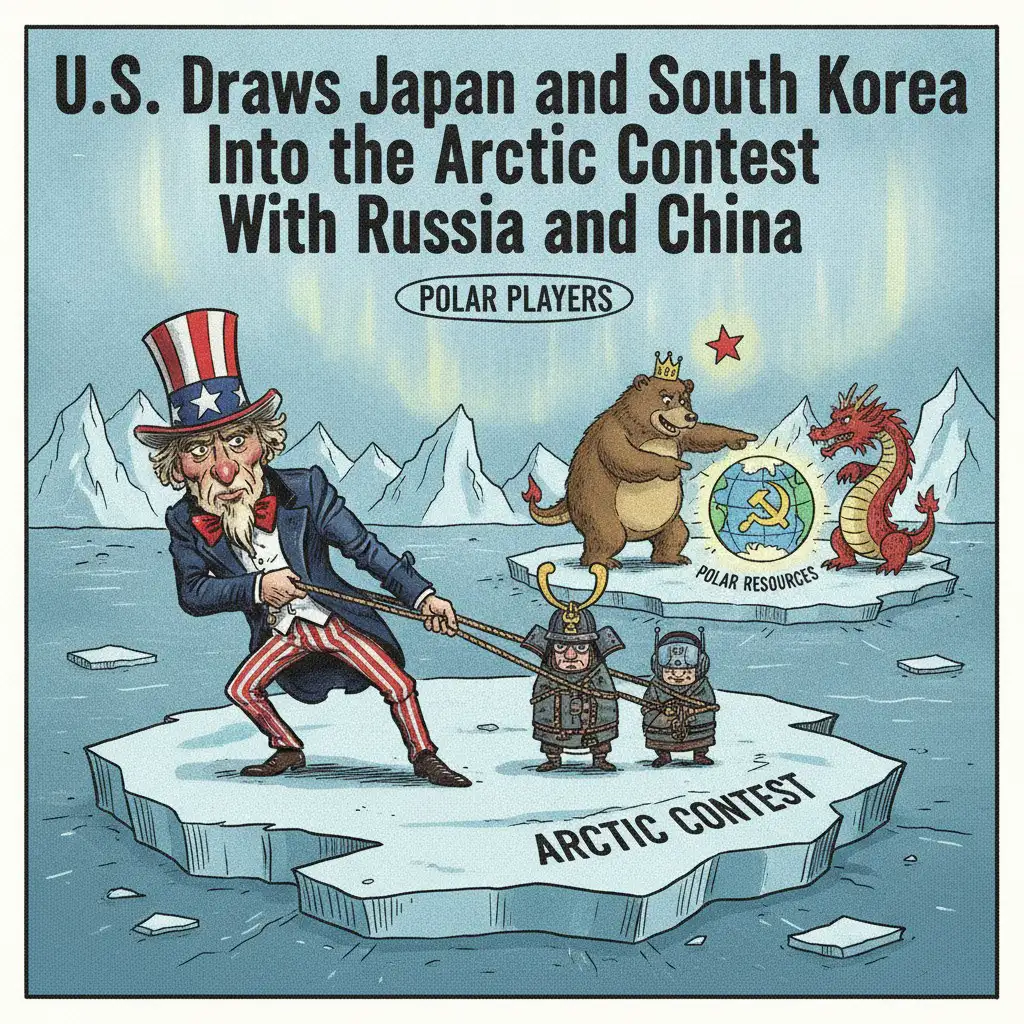
The U.S. Draws Japan and South Korea Into the Arctic Contest With Russia and China
What's actually happening
Washington is stitching Tokyo and Seoul into an Arctic security picture that used to be almost entirely North Atlantic. In February 2026, NATO launched Arctic Sentry, a new command structure under Joint Force Command Norfolk built to track Russian and Chinese activity across the High Northunder NATO's Joint Force Command Norfolk in response to Russia's increasing military activity and China's growing interest in the Arctic. A Pentagon strategy paper the same year flagged deepening Russian-Chinese economic and military cooperation in the region as a core concern. Meanwhile, Seoul has been moving fast on its own track: in August 2026 the container ship PanStar Acro left Busan on South Korea's first commercial test voyage along Russia's Northern Sea RouteA South Korean container ship set sail for Europe via the Arctic in the nation's first commercial voyage on the route to test its viability, hoping to turn the southeastern port of Busan into a global maritime hub. Japan, for its part, keeps framing its Arctic role around science and international law rather than hard security, even as it continues buying Russian gas. Think tanks like Hudson Institute and outlets like Breaking Defense have gone further, floating an informal "Arctic Quad" pairing the U.S. and Canada with Japan and South Korea to plug what they call a security gap in the North Pacific.
Why it's happening
Three forces are pulling these countries together. First, melting ice is turning the Northern Sea Route into a real shortcut, potentially cutting roughly 7,000 kilometers off the Busan-Rotterdam run, while the region is thought to hold something like 13 percent of the world's undiscovered oil and 30 percent of its undiscovered gas. Second, chaos elsewhere is pushing traffic north: the 2026 Iran conflict closed the Strait of Hormuz and left the Red Sea dangerous for shipping, so allies with heavy trade exposure are looking for alternativesthe closure of Hormuz and severe disruption to Suez traffic has imposed massive costs on the global economy, prompting American allies to look north to the Arctic, with South Korea and Japan signaling interest in both commercial routes and a defense role alongside NATO. Third, Russia and China are visibly coordinating: Chinese firm NewNew Shipping is investing in Russian port infrastructure at Provideniya Bay, Chinese research vessels have been tracked by the U.S. Coast Guard moving through the Bering Sea, and Russian-Chinese coast guard cooperation dates to a 2023 pact. Add Russia's roughly 40 percent rise in Arctic military spending since 2020, and Washington sees an opening to lean on two treaty allies with serious maritime capacity.
Implications
In the near term, expect more joint planning and information-sharing pacts, following Canada's recent classified-information agreements with both Seoul and Tokyo, plus continued investment in ice-class ships and icebreakers on the South Korean side. Longer term, the risk is that a region long defined by scientific cooperation drifts toward something closer to the Baltic's more militarized posture, complicating the already-frozen consensus at the Arctic Council. There's also a real contradiction sitting underneath South Korea's approach: Seoul backs sanctions on Russia while simultaneously coordinating with Moscow on safe passage for its own Arctic test voyage, a tension that drew criticism at home and abroadthe project risks friction with Western allies hoping to keep Russia isolated during its war in Ukraine, and Seoul has consulted with Moscow about the journey. On trade, it's worth noting the route is still overwhelmingly Russian and Chinese cargo. Traffic hit about 37 million tonnes in 2025, dominated by Russian LNG and crude exports, so Korean and Japanese gains so far are more exploratory than proven.
Scenarios and competing narratives
One path is gradual institutionalization: The informal Arctic Quad hardens into something resembling NATO's Nordic setup, with regular joint patrols and shared port access. A second is managed rivalry, where Japan and Korea keep hedging, preserving trade with Russia and China while quietly building capability, without a formal new alliance. A third, less likely but not trivial, involves an actual incident at sea, say a close encounter between allied surveillance assets and Russian or Chinese vessels, that accelerates militarization faster than anyone currently plans for. The narratives differ sharply by capital. Washington and its allies describe this as defending a "rules-based order" against authoritarian militarization of a fragile commons. Moscow calls it NATO encroachment on Russian sovereign waters. Beijing describes itself as a legitimate "near-Arctic state" pursuing science and commerce, and frames U.S. moves as containment. Seoul and Tokyo, notably, still talk about their own Arctic interests mostly in economic and scientific terms, even as they get pulled into a security framing that isn't entirely their own choosing.
Sources
Hudson Institute — How We Turn Northern Sea Route Advantage
https://hudson.org/defense-strategy/how-we-turn-northern-sea-route-advantage-liselotte-odgaard
USNI News — NATO Launches Arctic Sentry in High North in Response to Russian Activity
YouTube
Russia's Arctic Expansion Is Changing Global Power —
https://www.youtube.com/watch?v=CKMfpuvjf8Q
The Growing Strategic Importance of the Arctic (GZERO, feat. Thomas Dans) —
https://www.gzeromedia.com/video/gzero-reports/the-growing-strategic-importance-of-the-arctic
One Network, One Switch: How Starlink Dependency Can Turn War Chaotic
The core problem
Armies used to spread their communications across radios, fibre, military satellites and couriers. Starlink changed that. Its terminals are cheap, quick to set up and hard to jam, so units came to rely on it for almost everything.
That convenience creates three risks. The first is operational: if one network degrades, many units fail at once. The second is strategic: a company or a foreign government decides where and how fast the service works, and that decision can shape the war. The third is escalation. Choices about coverage can decide which strikes happen, and adversaries may start treating the provider as a combatant. One Russian TV host even called for a nuclear blast in space to destroy Starlink satellites.
Case study: Ukraine, October 2026
Overnight into October 14, SpaceX put a speed restriction on Starshield, the military version of Starlink, used by Ukraine's forces. It came with no warning and disrupted several missions. The Defence Ministry said real speeds during the day were even lower than the stated cap. Ukraine's 7th Air Assault Corps said a drone unit near Huliaipole had to cancel missions.
The sharpest reaction was reported by Politico and repeated by Ukrainian outlets. I couldn't open Politico's original article, so treat the wording as reported. One drone commander called the slowdown comparable to a nuclear strike on his unit and said it would cost many lives. His unit flies Hornet drones that use Starlink for control and navigation against targets up to 150 km away, and he said medium-range strikes stopped.
Why would a slowdown hit this hard? Mid-range strike drones and interceptors fly fast. Interceptors are Ukraine's main defence against Russia's jet-powered attack drones. Force a drone to fly slower and it becomes easier for enemy air defences to shoot down.
The 100 km/h claim
The figure needs care. This week's reports describe a cap of 100 mph, or about 160 km/h. A 100 km/h limit was reported back in 2023, based on a Ukrainian military source.
The exact cap may matter less than the instability below it. Reuters reported drones losing their connection for up to 20 seconds at around 110 to 120 km/h. At 120 km/h, a drone covers roughly 650 metres in 20 seconds. During that time the operator has no live video and can't steer. A strike drone can miss its target or crash. An interceptor can lose a Shahed, which then hits its target. That's the chain by which a technical setting can cost lives. Zelensky warned that people will die if the service isn't restored.
Who controls the switch?
Musk said Starshield belongs to the US government and its speed limits are set by the US military and ultimately the President. Ukrainian officials suspected the move was tied to tension with Washington, but they offered no evidence, and the White House hadn't commented.
This isn't the first time. Reuters reported that Musk ordered coverage cut during Ukraine's 2022 Kherson counteroffensive because he feared a nuclear response. SpaceX hasn't publicly confirmed that. The uncertainty does its own damage. In the middle of a fight, a commander can't easily tell jamming from a software glitch or a political decision.
The benefits are real
Starlink kept Ukraine connected after Russia damaged and destroyed its networks. In 2022, a Pentagon official praised how quickly SpaceX countered a Russian jamming attempt.
The same control can also help. SpaceX's January speed limit was aimed at fast Russian drones guided through Starlink. One Ukrainian general said blocking Russian access cut Russia's drone campaign by up to 40 per cent. He also said only another Starlink could replace Starlink. That one line sums up both the benefit and the dependency.
Weighing it up
Starlink gives troops connectivity and resilience that nothing else offers at this price or scale. Leaning on it also means accepting a single point of failure, policy decisions made far from the front, sudden throttling and leverage held by outsiders. Europe has discussed alternatives, but none match Starlink's scale yet. Until one does, any army that depends on a single network depends on whoever controls it.

