



Ch15-Purushottama-Yoga
 Bhagavad Gita at Work
 Ch15-Purushottama-Yoga

BH Gita Ch 15 - Purushottama Y


Bhagavad Gita Cha 15 - Purushottama Yoga
Verse 1-4
This is a symbolic presentation of sansar’s origin, Gyan (Vedas leafs). This sansar is created due to the Yoga Maya of Bhagawan (Brahman) with stems as ever-changing nature of sansar.
This sansar is represented by this tree. This sansar rupi tree must be cut to go beyond the nature to reach Brahman. Mana, Budhi, Ahankara and Cit need to be understood.
Vasanas exist in Cit. As we start cleaning these vasanas we start reducing the effects of Ahankara (shadow of vasanas). One needs to clean vasanas from Cit: Cit-shudhi.
There are two ways to clean Ahankara:
1. In deep sleep, we experience it without Ahankara.
2. Light the entire area of Cit.
Example: Entire Mountain is sansar; path to reach at the top of mountain is your stem; the peak is destination. Once you reach at the peak, you can see different paths.
· Karma yoga is to reduce the quantity of thoughts
· Gyan yoga is to improve the quality of thoughts
· Bhakti yoga is for the direction of thoughts
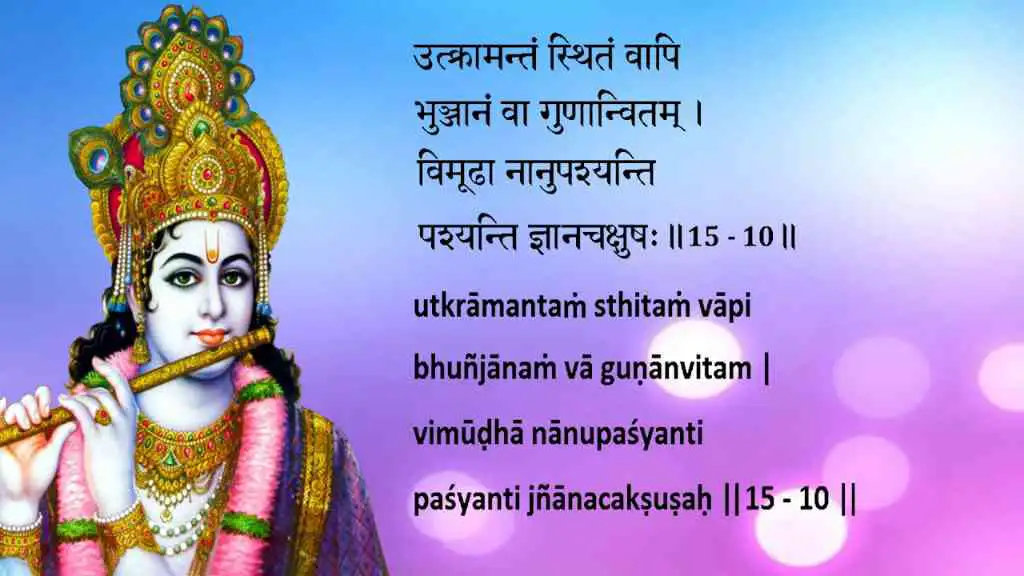
Verse 5-10
In Spirituality, we need to see how much of knowledge is applied into our daily experience.
We must look inward (inside of you). It is the same Brahman that dwells within you in the form of inner divinity. Things are happening according to the nature. We must accept that everything is happening according to nature without attaching our emotions (reaction) on to it.
Seeing things as they are. Leave your reaction as it is, e.g., if you go near fire, you feel heat. Accept this.There are few key steps req uired to accept all reactions as it is. If I am getting angry or happy accept it as part of prakriti – nature. You can do this while doing your daily activities.
In normal life – corrective instinct is considered as part of desire. For example, if you are surrounded by people who are saying which is not right and you try to stop reacting towards it.
Similarly, inside you here is a need to correct it – accept it. If there is a strong desire and you accept it as a desire. One needs to try it. When you try to correct a situation and that situation is not changed. if you do not get affected by it then your awareness expands. In Ajna chakra – it penetrates through time. Your time is not relevant. From here, you go towards Crown Chakra.
Heart chakra will take you towards Oneness - unconditional love.
Verse 11-15
Explaining the True Nature of Bhagawan – Purushottama.


Bhagavat Gita – Chapter 15: Purushottama Yoga
Verse 14-20
When I merge with the Parmatma, then “I” goes away. Every Jivatma comes through this nature (five elements) and it gets affected by these sansarik activities. Jivatma is like sun rays and Parmatma is the Sun (source of all energy).
In this Sansar, Upasana, meditation are different paths to reach Brahman. But this is not the subject of senses and mind. We must go beyond the mind to merge with Brahman.
Verse 14 – Prana – energy; Apana – the one which takes away the waste. Universal Prana and Individual prana – when both are connected then your awareness increases. Then, you can acquire some siddhi’s. My awareness is limited with oneself. When awareness starts increasing you can connect with other human beings, and you start understanding other people’s problems. Slowly you will open your third eye – beyond time.
Verse 15 – I reside in everyone’s heart as Bhagawan. The “I” goes away. This is the first stage of enlightenment where you experience Bhagawan through Heart Chakra. I and this Sansar is one. Unconditional love Bhava eliminates all relationships between you and everyone else.
Verse 16-17 – When we talk about Jnana (Gyan), it is related to Jivatma and Parmatma. There are two types of purusha – one which is destructible and other is indestructible. This universe is all perishable. When quantity of vasanas is less then you start going towards whiteness. At the same time, you can visualize transparent and the Sansar. Bhagawan is related to Bhakti yoga. But when you start differentiating between Jivatma and Parmatma, we are looking through the prism of Jnana (Gyan) Yoga (mind and intellect).
Verse 18 – Purusha – the one who remains after pralaya. Prakriti – Uma devi, the power behind this universe. Pragyanam is for Atma (beyond mind and intellect). This is not gender related. It is to explain this spiritual knowledge.
Verse 19 – Janati - the one who is not deluded, understands Me as Purushottama. Every belief is like a hand brake with your car that prevents you from achieving the high speed.
Verse 20 – This knowledge is an extra ordinary that I have shared with you Bharat (Arjun). Arjuna is addressed here as Bharata because he is knowledgeable now. Every marga come with different tools – Bhakti, Jnana (Gyan), Karma. Bhakti is bhava Pradhan. Till you have Bhagawan in your heart you are on the path of Bhakti yoga. When you are focused on Parmatma – you are on the path of Jnana (Gyan) Yoga.

