



Ch13-Kshetra-Kshetrajan-Yoga
 Bhagavad Gita at Work
 Ch13-Kshetra-Kshetrajan-Yoga

BH Gita Ch 13 - KshetraKshetra
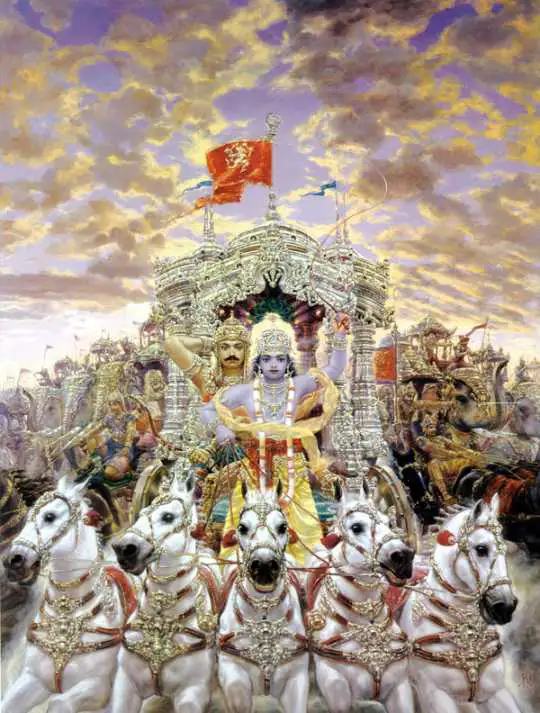


Bhagavad Gita Ch 13 - Kshetra Kshetrajan Yoga
Verse 1-4
Kshetra – field of activity; there is somebody who knows this field of Kshetrajna. You know the activities through awareness. Me and my body are two different things. When you look at the objects in the external world, we know that it is not me. But when you look at yourself (body), you forget that this is not you. You are the knower of this body. Here the difference between the body and the knower of the body is not obvious. Once you have this knowledge you are called Jnanai (Gyani).
Bhagawan is saying that I am the knower of all activities of the Kshetra. The consciousness which is illuminating all activities of body and mind makes you aware of these activities. When you observe some objects during the presence of light, you forget that value of light. Similarly, when some thoughts come to my mind, we only become aware of this due to the light of consciousness.
We never pay attention to the activities that we perform. Why we can perform those activities. What is that source of energy or power that allows me to perform these activities. What is that power to absorb the oxygen in your body is not a physical power. It is that super consciousness.
This is a journey of spirituality where our relationship changes with Bhagawan:
· My relationship with external world
· My relationship with Bhagawan
· My relationship with myself


Bhagavat Gita – Chapter 13: Kshetra and Kshetrajna Vibhaga Yoga
Verse 10-11
What is the boundary of your universe? Suppose someone is focused on earning money and deriving pleasure from the external world.
Someone said this and that, then that person gets affected by that stimulus.
One needs to withdraw from these external world’s activities on a path to spiritual journey. Someone will be interested in this world while another person will say that this world is not meant for me. Someone says now I am interested in studying Gita. The same sansar where I used to be engaged is no more attractive to me. Now this spiritual world is different, slowly in this spiritual world a person starts moving towards yoga-engaged vs. bhog-engaged. As your desires lead you towards Geyam and starts preferring Ekant (alone), because he/she is no more engaged in this external world.
Verse 7
Amanitvam – humble; adambhitvam – taking pride based on other’s status (Dambhi)
Ahimsa – mansik and vaicharik – you don’t think like harming, and you don’t feel like harming.
Arjavam – simplicity – the one without complexity; ksantir – patience; You can forgive someone, but real attitude will come when you are happy to help him.
- With ahankara, you cannot learn anything in journey of spiritualism. When you want to achieve something, you need to bend. You must continue with the attitude that Guru can help you on the journey of spiritualism. Guru watches your personality – how you are improving? Guru used to look at your personality and their goal was to develop your personality – personal development – chita shudhi.
- Kshatriya will get different knowledge versus the knowledge to be imparted to a Brahman.
- Trader’s personality will be developed according to trader’s personality with integrity and truthfulness. Your thought process needs to be cleaned.
- Sthairam – unwavering towards duty; atma-vinigrahah – self-control – you are not driven away by the shining objects.
Verse 8-9
- Indriyartheshu – non-attachment towards sense objects. Current marketing is based on creating/generating desires to achieve some objects. You are now not affected by this marketing.
- All these gunas are related to chita shudhi. The experiences of your past life and current life are attached to your chita – all bhavas are generated from this chita. The agitation occurring on the platform called chita will cause you to act, which creates desires in you that forces you to act again. In Chita shudhi, you try to reduce your desires. You get angry due to some vasana, in this situation, your goal should be to clean your vasana, which is causing this angry behavior.
- Suppose you stay calm in adverse situation that means your chita shudhi has occurred to a large extent.
- Quantity (Karma yoga), quality (Gyan yoga) and direction (Bhakti yoga) of vasanas will determine the path to clean these vasanas.
- Sattwa, Rajas and Tamas gunnas are there in everyone nature. People behave according to the dominant guna. Then we have tried to understand the ignorance like scratches made on the glass which creates a shadow. We try to remove the shadow and not the scratches. This is called ignorance.
Bhagavat Gita – Chapter 13: Kshetra and Kshetrajna Vibhaga Yoga
Verse 12-13
Geyam (Jnanayam) – the knowledge that is to be known.
Sat – existence and Asat – Non-existence. The Brahman is beyond existence and non-existence. Brahman is not dependent on existence and non-existence.
Bhagawan – Nirgun becomes manifested as Bhagawan (Sagun Brahman)
Parmatma – When atma merges with Brahman
Brahman – for Gyani (Jnanai)
Same person is father to his children; husband to his wife; brother to his siblings.
When you can observe something, you cannot be an object. You are the knower of your thoughts that means you are not the thoughts.
Verse 14-15
In Dwait, the truth that we know is dependent on pure existence. Earth is dependent on Sun. When you realize that you are not dependent on something else, then you merge with Brahman. Brahman is not dependent on anything; it is beyond sat and asat. Brahman is Anadi – beginningless – absolute TRUTH.
As long as I am dependent upon something, I have not recognized my True-Self.
Pralaya – the projection of the Brahman goes back to Brahman. The wave comes back to sea.
Verse 15 – It can be experienced through meditation.
Prana – Sukchma – thoughts; the brain is big.
Verse 11-12
Vidya – Spiritual knowledge
Avidya – Nature knowledge, prakriti – mind is inert; one cannot perform any duties without mind. Kurukshetra – mind; there is a kshetra called Dharma kshetra – Atma.
Any knowledge of Brahman, Consciousness – Vidya.
The knowledge that will take you towards amritam – immortality. Everything is channeled through the same energy (Brahman).
Even all devatas have the same source of energy. You can experience (anubhuti) this Brahman. When one starts seeing the same Brahman in everyone, then that person moves beyond Dwait.
Fundamental Principles:
- Nirguna Brahman
- Saguna Brahman
- Manifestation
- Physical
- Cit – vasanas are not physical
- Neither physical nor energy which consists of total Brahmand – they can influence the physicality, but they exist in non-physical state
- Shri Krishna avatar has absolute control for physical and non-physical
- Planetary energies affect the events in your life. Shani gives the results of your actions.
- Similarly, devi and devatas affect your life events
- Nirguna and Saguna Brahman affect your life events – mind, Cit and physical events
- There is a trigger – Shradha that invoke energies through Mantra
Bhagavat Gita – Chapter 13: Kshetra and Kshetrajna Vibhaga Yoga
Verse 19
In Dwait, we have a sadhya in Bhakti Yoga. He or she is focused on experiencing the Bhagawan.
Shiva and Shakti (energy) together create the manifested world.
Stage 1: Oneness – I and universe are one. Bhakti has no meaning for such a person. First stage – universe exist under the influence of time – is related to Heart Chakra. Bhagawan exists in heart.
Stage 2: You start experiencing the maya.
Verse 20 – As long as we are under the influence of ahankara Karma is there, which is part of prakriti. Your bhava (action with attachment to results or without attachment to results) determines the experience of “pleasure and pain”. I feel good due to activities occurring around you. Once you go beyond bhava, you go beyond three Gunnas.
But Shreyas is Pradhan. Preyas is there under the control of desires. All these actions and cause of actions are happening due to prakriti.
When you are in oneness, you do not need to talk about it. You do not tell everyone that everything is one.
Verse 21 – In Manav yoni, your consciousness can expand.
Verse 22 – Bhokta – experiencer; Maheshwar – Maha Ishwar; Bhakti is related to Bhagawan.
In Jivatma – we talk about Parmatma. It is the same Supreme consciousness talked about in different form.
Verse 23 – The one who knows Purusha and Prakriti and has reached Moksha, does not take re-birth. As you continue to differentiate between Purusha and Prakriti, you reach towards Being.
Verse 24 – 25 – You can follow the path of Karma yoga, Gyan yoga and Bhakti yoga to reach Brahman. Also, you can reach Brahman through listening to Gyani.
Verse 26 – Whatever you observe in the nature is due to union of knower and known.
Verse 16-17 - We try to understand the Brahma with the attitude of physicality. In Dwait, we always consider I and Brahman as two different entities.
Understanding – Knowing (Anubhav) – Being (merging with Brahman)
Bhut – in existence. Mind has limitation with the manifested world. Therefore, mind is playing in the manifested world.
But Knower is beyond the manifested world.
Sometimes, we assume awareness as consciousness, which is not true. I am aware of our image in front of a mirror. But animals are not aware of themselves. Tree’s awareness is lower.
Awareness is dependent on consciousness to cause this awareness.
The light due to which we become aware of our thoughts. This light is not limited and is utterly unaffected by any objects.
Everyone tries to quench the desires coming out of the agitation caused by the vasanas. Under the influence of the time, we created Brahma, Vishnu, and Mahesh.
Verse 18
- In Gyan (Jnana) yoga we consider Bhakta who reaches Brahman (ME) through meditation.
- In Karma yoga we consider Karama yogi who reaches ME through Karma.
- In Bhakti yoga, we consider Bhakta yogi who reaches ME through Bhakti.
When we go beyond the current nature of mine through continuous Bhakti that is called Ananda (Anubhav). Mad-bhava – one can experience (Anubhav) this through continuous Bhakti.
Verse 19
- Purusha – Brahman (Consciousness), which is not changing.
- Jivatma – Parmatma to indicate different bhava.
- Bhakti – Bhagawan (personal bhakti).
- Prakriti – Changes continuously.
- Budhi – instinct is to discover the ultimate Truth.
- Maan – instinct is to discover permanent happiness.
- Physical body – instinct is to become immortal.
Bhagavat Gita – Chapter 13: Kshetra and Kshetrajna Vibhaga Yoga
Verse 26
All living creatures and non-living items (tree, rocks) are born out of the union of knower and known.
Verse 27
Everything in nature gets destroyed in nature. The one which does not get destroyed is Brahman. The one who sees this Brahman in everyone is the one who sees this.
There is prakriti which is doing everything. The other thing is Parmatma. Prakriti exists due to Parmatma. Example: Cloud exists in Aakash. When cloud goes away, the only thing remains is Aakash.
The science has discovered that there is no matter. Everything is energy.
Verse 28
The one who understands that Parmatma is never destroyed with the destruction of body. In the context of Kshetra and Kshetrajna, everything is changing in Kshetra.
Verse 29
When one tries to drink a glass water, what makes you go towards the glass of water? That shakti is also part of Brahman. The change of state is due to shakti in the presence of nirgun brahman that creates Sagun brahman. In Bhakti, we say Bhagawan is inside me. We exist in Bhagawan ki Prakriti. The prakriti expands in the presence of Nirgun Brahman.
Verse 30
Maya – it appears that something exists. When a tree falls on the ground, it creates the vibrations. This vibration is interpreted as a sound by the brain. That sound is interpretated by the mind that a tree a fell. The entire interpretation of Kshetra is due to Kshetragya. The one who understands this knows Brahman.

