



Ch04-Jnana-Karma-Sannyasa-Yoga
 Bhagavad Gita at Work
 Ch04-Jnana-Karma-Sannyasa-Yoga

BHG4-Jnana Karma Sannyasa Yoga


Shri Bhagawan Uvaca:
Verse 1
Lord Krishna is saying that I gave this eternal knowledge to Vivasvan (light of knowledge, Sun god). Then, Sun passed this knowledge to Manu. Manu passed this knowledge to king Ikshvaku.
First knowledge (Jnana) before manifestation is signified with Sun (Sun God – energy with consciousness). From Sun, it was given to Manu. Then, it was passed on to Ikshvaku (lineage of Lord Rama).
Arjun Uvaca:
Verse 2
Thus, received through succession to royal sages learned. Over a long period of time, this knowledge was diluted. Every person has this knowledge, but it is covered with cloud (ignorance), so the light of energy is hidden.
Experiment with Dog who have a specific field of knowledge. Through this knowledge of information dog can figure out when his master will return home.
White noise diodes were created and installed in various places around the world. The objective of this experiment was to find out if there is an untoward event going to happen. 9/11 event was detected by these diodes before it happened. There is a field of information that is available specifically to various animals, birds etc.
Spiritual Implication – everything that is happening in this universe is already recorded in the universal memory (cosmic knowledge). When you are connected to that universal knowledge (yoga-rudha), you can download that information.
There are two types of knowledge – prakriti knowledge and knowledge before prakriti (parmatma knowledge). In western world the knowledge is limited to prakriti knowledge.
Once you reach or get connected to this unlimited reservoir of knowledge, you can understand everything about universe.
Verse 3
I parted this ancient knowledge to you, because you are My devotee and friend. This is why I have told this highest secret to you. These teachings of Sri Krishna are not easily grasped by people, so they remain secret.
Verse 4
Arjun is confused about Sri Krishna who was born later than Vivasvan. Then, how it is possible for you to teach this first to Sun God?
Shri Bhagawan Uvaca:
Verse 5
For Me, there have been many births and for you also, Arjuna. The difference is that I remember them all and you don’t. When we go from higher level to lower level, we call them Avatar. When we go from lower to higher level, we call them Rishi.
Braham Rishi – the one who takes you towards Brahma Gyan. The other Rishi’s are the one who take you towards prakriti. Whenever some impurities arise in your knowledge, it becomes diluted.
The control of prakriti – the knowledge has to be applied in the context and situation you are engaged. For Arjuna, since he is engaged on the battlefield, he has to fight. Vishwamitra’s knowledge of weapons (Agni ban) has to be applied in the field of battlefield.


Bhagavad Gita – Chapter 4 – Jnana (Gyan)-Karma-Sannyasa Yoga
Sri Bhagawan Uvaca:
Verse 6
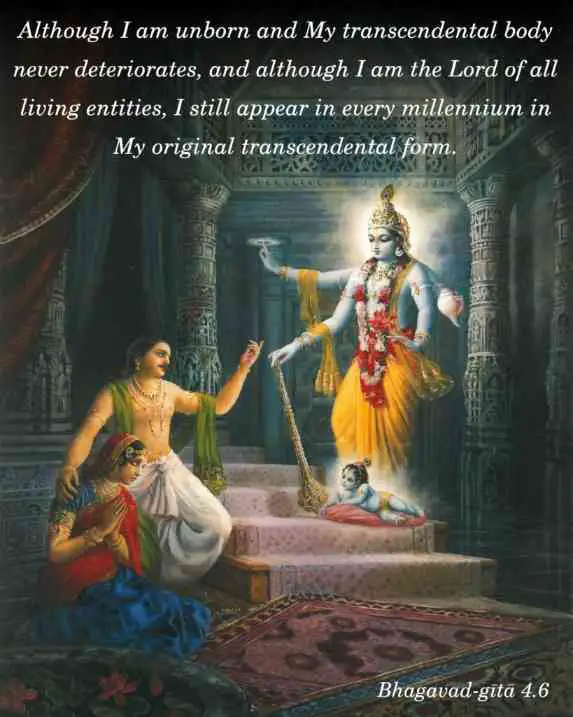
Although I am unborn, eternal and Bhagavan of all beings, holding nature under My control I take birth through My own power (atma-mayaya).
Question – why Bhagawan has to take birth to create the balance between dharma and adharma?
Discussion – In the context of Karama-yoga, Shri Krishna is giving answer according to “Iness” and “Myness”. Arjun is asking questions related to his physical identity. So, Shri Krishna is providing answers in the context of “I exist”, but other than me there is something else exist. So, I exist and Bhagawan exist during this time. Mind is curious to ask questions. When I merge with the supreme consciousness, then mind stops asking questions and we reach to Oneness.
Once we start asking questions, answers will continue to take us in the past events one after another. Ultimately, we reach to the point where our “Iness” and “Myness” goes away. We are aware of only fraction of the energies that exist in this Brahmand (universe).
Reference – Verse 11 – Bhagawan says I bless people according to the way they seek Me or they remember Me.
Meditation on “Namaskara Bhava”
We perform collective mediation starting with two deep breadths. Then using the namaskara bhava recognized everything around us including – physical things (tress, house plants etc.), family members, friends, relatives, people known to us and not known to us. Continue with namaskara bhava towards physical body parts, subtle body parts, the energies supporting us, energies from the past life, everything in this galaxy, your family Gods….
Bhagavad Gita – Chapter 4 – Jnana (Gyan)-Karma-Sannyasa Yoga
Sri Bhagawan Uvaca:
Verse 9-10
There are three steps involved to get full grasp of vasanas:
Step 1 – Understanding; Step 2 – Experiencing; Step 3 – Becoming
Knowing alone this fact will not clear all vasanas. Slowly, a person starts clearing-up the vasanas. When such a person takes birth, he/she takes birth as a Jnani (Gyani). Once a person becomes One (with Bhagawan) and realizes that realty because of which I’svarah exist & everything in this universe exist including you and I becomes enlightened. In other words, one who discovers this eternal truth becomes enlightened.
Verse 11
Shri Krishna is saying that people who worship me in whatever form (bhava), I will bless them accordingly.
Verse 12
What is the process for performing an action?
1. Desire arises in the mind; the intense desire forces you to act
2. The once you reach the desired results; that desire goes away
3. Then, next desire will arise and the process continues
The realty of your True Nature is to be calm; since we are engaged in external world we think that by fulfilling this desire, actions have to be performed. That person who knows the mind and the desire of mind worships the True Nature of Bhagawan. The other person worships without knowing the true nature of bhagawan and gets engaged in fulfilling the desires in the external world.
The one who is enlightened will not get affected by the desires and does not allow his/her mind to be affected by these desires.
Verse 13-14
Bhagawan created this world and divided them in four groups (varana) based on three gunnas – sattwa, rajas and tamas and actions/activities performed by them. Shri Krishna is also saying that even though I have created this world, yet I am not the participant in this creation. Like Sun rays are falling on this planet and illuminating everything on earth, yet Sun is not affected.
Action – karma; inaction – no karma; un-action – not the owner/doer of action.
When you reach to the stage where you do not identify yourself as the owner of action, you become the awareful witness as your True Nature (inner divinity).
Bhagavad Gita – Chapter 4 – Jnana (Gyan)-Karma-Sannyasa Yoga
Shri Bhagawan Uvaca:
Verse 15-16-17
You should perform your actions with full force (using all skills). Yet, you should not be engaged as an owner of action. Once you feel that you are the owner of action, you will start worrying about the results of actions (success/failure).
Swadhyay:
Introduced the concept of Bhakti-Pheri and Bhava-Pheri.
Principal: I always performed actions for myself. Now for an hour, I will withdraw myself from the actions – neither owner of actions not the owner of the results of action.
Example:
For some time, we do Bhakti-Pheri and devote all actions performed for Bhagawan (I’svarah Arpan budhi). Once a group fishermen started performing their actions with this attitude for others. Slowly, fisherman started working with this attitude for a day in a month and accumulated a lot of money. Then, they used this money to buy boats. Slowly, they accumulated 18 boats and started earning more money. Then, they started a school and kept a clean place inside the house. Thus, this bhava (doing actions for others) transformed their habits in daily life. When we perform actions without getting engaged in actions (I am not at the center of actions), we start changing our samskara.
Karma-yoga-su-kaushlam – Actions must be performed with full skills.
- Karma, Akarma and Vikarma
- Vikarma (special karma)
- Inaction – Tamsic attitude
- Wrong action – guided and controlled by Tamas and Rajas
- Right action – controlled and motivated by Rajas and Sattwa
- With what attitude (bhava) you are performing your actions is the key. Your attitude decides the quality of action performed. With what attitude (bhava) you are helping someone. Am I doing this to get something in return? Am I doing this so that someone can benefit? When someone crosses the boundaries of “Iness”, then their action becomes pure with full realization of spiritual gain (action performed with prasad budhi). Then, there is no bondage with action.
Verse 18
Although I am not doing actions, but actions are happening. A person who performs his/her action with this attitude is called wise among the men. That person is matured and spiritually accomplished.
Bhagavad Gita – Chapter 4 – Jnana (Gyan)-Karma-Sannyasa Yoga
Sri Bhagawan Uvaca:
Verse 19-20-21-22
Yagya – any dedicated positive action
Verse 24
In realty, everything is a manifestation of the same brahman (consciousness). When someone sees everything from the perspective of underlying realty (brahman), then that person’s bhava is changed with respect to his/her actions:
Level 1: Brahma Arpan
Level 2: Pranayama Arpan (aware energy)
Example: When the number of electrons, protons and neutron changes in a material, the property of the material changes – one becomes gold, other becomes silver.
Other discussion topics:
- Awareness is not being able to project itself in the form of stone, e.g., when a bulb is fused, the light cannot be projected.
- Everyone knows that I am a conscious being. At the same time, others are also conscious being.
Verse 25
Everyone performs yagya using different path/actions – someone worships to invoke God’s blessings others meditate. Till “Iness” is there, we are talking about “Dwait”. The state of being is related to nirgun brahman.
Verse 26-20
Describing the same concept.
Bhagavad Gita – Chapter 4 – Jnana (Gyan)-Karma-Sannyasa Yoga
Sri Bhagawan Uvaca:
Nirgun brahman and Sagun brahman. Both are beyond three Gunnas. When Bhagawan Shri Krishna came on this earth, He is controlling Gunnas and we can say He is Sakaar.
Verse 31
Yagya (Havan) – positive action dedicated for others’ benefit. The one who does not perform yagya, he is limited to his own area of action. The spiritual journey begins when you perform actions without any personal agenda. It has immediate positive effect on the mind of a person.
Verse 32
There are many kinds of yagya performed without “Iness” for the benefits of others. Then you reach brahman (moksha). Once you become brahman or merged with brahman, you are not affected by the activities of mind, yet engaged in daily activities of life without “Iness”.
Verse 33
When we discuss things: we have some level of “Iness”. When we attach Shradha, then we talk about Jnana (Gyan) Yagya and your attitude becomes pleasant.
Verse 34
The new knowledge will come when you have space in your mind in the path of spiritual journey.
Verse 35
Bhagawan is saying that once you reach that level of spiritual knowledge, then you will see that all living beings are in Me. When you are between the stages of knowing and being, then you are still in Adwait stage.
Hindu philosophy is based on a seeker who continues to strive for more answers till he/she reaches brahman.
Verse 36
The fundamentally everyone knows that I should not be hurt, nothing should be stolen from me. Whenever this (hurt/stealing of an asset) happens, we call it an act of sin. When we talk about budhi, then people define the sin based on a belief system. Now you are at a lower level.
When you are on a spiritual path, you slowly reach brahman with this knowledge about your True-Self/Inner Divinity. This Jnana (Gyan) is available to you all the time. Sense of fulfilment comes when you give in the external world.
Verse 37
O Arjuna, the fire of knowledge reduces all actions to ashes like a kindled fire reduces wood to ashes. As you start committing acts of dharma, your punya karma start growing.
Verse 38
Whenever you start removing falsified identifications you start reaching your True Self. When you start removing impurity using spiritual tools (Chitta Shudhi), then you start realizing your true identity – moving from understanding to knowing through yagya-karma. Eventually your inner divinity is revealed like sun is revealed when cloud disappears.

