



Ch02-Sankhya-Yoga
 Bhagavad Gita at Work
 Ch02-Sankhya-Yoga

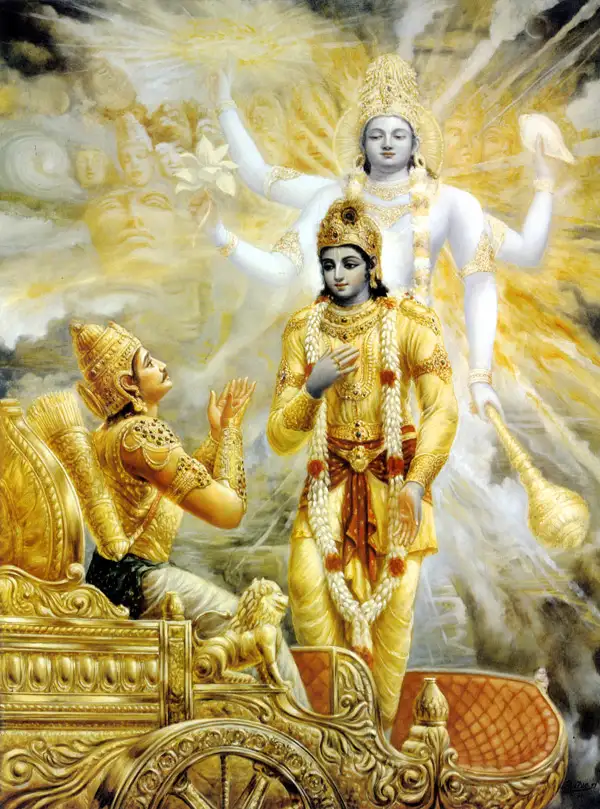


Question: What is Dharma? How to implement dharma in real life? – It is exceedingly difficult to implement Dharma in this complex world.
Ahimsa Param Dharma – Follow the path of action which causes least harm to you and others
Shri Krishna is sharing His vision of world’s order, His vision of realty so that Arjuna’s grief can be removed. Even He knows that some of his family members will die on the battlefield of Mahabharata. Yet He has a different perspective. In a moment of crisis some people remain calm, and some people freak out. The difference is in their perspective about vision of realty of Universe.
Shri Shankaracharya about Verse 11/Chapter 2
Shok Moh Bhyam Abhibhoota Viveka Vigyan – Arjuna’s suffering is indicative to sansara sufferings. We lose our ability to think clearly due to grief and emotional distress.
Verse 11 – Spiritual preaching’s of Bhagawan Krishna starts here
Ashochya nanva shochas tvam - You mourn for those who need not be mourned
Pragya Vadansch Ka Bhasase - and yet you speak words of wisdom.
Gata Soon Gata Sunshcha - For the dead and for the living
Nanushochanti Panditah - the wise mourn not.
Gata Ansu – have breath; Pragyavadansch – Wisdom; Na Anushochanti – do not grief; Panditah – genuinely wise
Shri Krishna is saying that you are grieving for someone who does not deserve to be grieved.
Verse 12 - Na tu eva aham – It is known that I; Na Asam Jatu – Never existed; Na Eme – nor these; Janadhiya – King; Na tu evam – neither you
From this time on wards neither of us will cease to exist. There was never a time when you and I did not exist. Shri Krishna has a different perspective about sufferings. Arjuna is focused on physical sufferings. The one who dies? The one who does not die? And the one who travels? – This is being taught by Bhagawan Shri Krishna in the next few verses.
Verse 13 – Yatha – just as; Asmin – In this; Deh – Body – the one who dies and gets burned; Dehin – The one who possess the body – someone inside; Kaumaram – childhood; Yauvan – Youth; Jara – Old; Praptir – acquires; Dhira – Wise person; Muhyati - Confused


Bhagavad Gita Chapter 2 – Sankhya Yoga
Verse 1
Sanjay Uvaca
Arjuna, who was full of tears and overcome by a strong feeling of sadness and regret, Madhusudan (Shri Krishna) said this to Arjuna, who was depressed.
Verse 2
O Arjuna – where are you getting this timid nature during this difficult time of the war? It does not look good on you. It is disgraceful. Bhagawan Shri Krishna is observing that Arjuna is incapacitated by his own emotions.
Verse 3
The intent that takes you towards unmanliness, take this weakness out of your heart and getup – O Arjuna. Bhagawan Shri Krishna is using harsh language to invoke his strength as a mighty warrior.
Verse 4
Arjuna Uvaca
How can I battle against Bhishma and Drona who deserve my reverence? How can I fight with them with arrows O Krishna?
Verse 5
It would be better for me to live upon alms than killing great teachers (Gurus). How will I enjoy the wealth which is stained with their blood? Arjuna is trying to leave the battlefield and would prefer to live a life of sannyasi implying that Arjuna is running away from his responsibilities. This is another part of his dharma.
Verse 6
Either we conquer them, or they conquer over me. Those who are ready to fight with me, son of Dhritrashtra. Which is better?
Verse 7
I am confused about what is my dharma. Arjuna is not able to decide what is better. I am your student. Having sought your advice, please teach me firmly what should I do? I beg you to teach me.
Verse 8
My sadness will not be removed even if I get the kingdom of the three worlds (lokas). In daily life we use intellect and mind to respond to sadness and happiness. When we reach spiritual maturity, we can view ourselves without getting affected by the real situation.
Verse 9
Arjuna said to Bhagawan Shri Krishna – I will not fight and fell silent.
Verse 10
Background is made till this verse 10. Sri Krishna spoke to the depressed Arjuna.
Verse 11
You are mourning for those who should not be mourned for. But you are talking about the right thing. 2nd interpretation – Bhishma and Drona are Gyani – spiritually matured, so you should not mourn for them.
Verse 12
There was never a time when you and I did not exist. In the future also, all of us will exist. I am a soul vs. I am the soul (atma).
Bhagavad Gita – Chapter 2 – Sankhya Yoga
Verse 12
There was never a time when you and I did not exist. In the future also, all of us will exist. I am a soul vs. I am the soul (atma).
Verse 13
Just like the body passes through the childhood, youth and old age, so is another body acquired. So wise persons do not mourn about this or confused about this.
Question: Have I changed?
Example: We make decisions based on my belief system – don’t talk to strangers, we say to child. This belief went into child’s mind. Child is behaving with that belief.
Who am I? I am not the belief? I am not the one that is projected after the belief. We accumulate some beliefs, and we discard some belief. So, I am the one before the belief. This “I” is always available for us to experience. Consciousness does not go through the change and allows us to see the changes of body and mind.
Verse 14
O Arjuna, all sense perceptions causing cold or heat, pleasure or pain, they come and go. They have a beginning and an end. Endure them O Arjuna.
Verse 15
One who does not get disturbed by the impermanent things, the one who faces pain and pleasure with equanimity. Such a person is a wise one and is fit to be immortal.
Verse 16
Important thing is to contemplate on this “I”. atma = sat (unchanging) cit (pure consciousness) ananda (happiness). For the unreal (untruth), there is no existence. For the real (Truth), there is no non-existence. The certainty of these both (existence and non-existence) is seen by the knower of the Truth. The impermanent does not have any existence. But the Truth is always there. It never ceases to exist.
Verse 17
Try to understand that the one which cannot be destroyed is the one which is pervading this entire universe. This atma which is indestructible cannot be destroyed by anyone. You should treat this as a subject.
Verse 18
These bodies belong to the immortal embodied being (atma). This embodied being is indestructible and measurable. Therefore, go fight O Arjuna. Shri Krishna is teaching that consciousness continues to exist and it is utterly unaffected by the physical body and subtle body.
Verse 19
The one who thinks that the atma can be destroyed and the one who thinks that the atma is a slayer. Both of them do not understand it. So, fight. As a body and mind, I become Ego. As a wave, I become jivatma. Sea is same. Water does not change. Once I experience the True Self, then everything becomes mithya (maya). You cannot experience a life of father till you become father.
Bhagavad Gita – Chapter 2 – Sankhya Yoga
Verse 25
When atma is identified with Cit (mind), it is jivatma. Cit is a repository of impressions. These impressions are not readable. Subconscious is related to this life impressions. When subconscious gets activated, then it comes into a conscious being, and it becomes recognizable. Then it projects as mind and intellect. When light of atma projected through mind and intellect, vasana gets activated. Then a shadow is formed, which is called ego.
My skin is brown, identification with body. My likings are this, this is identification with mind and intellect. We are not aware of the vasana associated with the desires. THIS IS WHY ATMA CANNOT BE TRANSLATED AS A SOUL. This atma projects itself into different identification – body, mind and intellect.
Verse 26
Even if you think that this self (jivatma) is constantly taking birth and dies, why should you mourn.
Verse 27
The one who is born, is going to die. You should not grief over things which are certain – related to Jivatma. This cycle of birth and death continues.
Verse 28
Anything which has life are unmanifested in the beginning, they exist (manifested) in the middle and become unmanifested at the end. Arjuna is addressed as Bharat. When the person who is being taken to that knowledge, then he is called the one who is reveling in knowledge. As your mind and intellect more developed, your ego drops. What is there to grief about. Atma takes different roles and gets identity as a body, mind, intellect, jivatma like a person takes different roles as a father, son and husband.
Verse 29
Atman causes us to understand. We cannot go back and try to make it an object.
Verse 30
This atma is eternal. But, due to association with different identification, it appears to be destructible.
Verse 31
Svadharma – you should not waiver to perform your duties (Svadharma). It does not look good for a warrior. Within the jivatma, the three gunnas are projected. The combination of these gunnas create a character of jivatma. Arjun’s personality is that of Chattriya. He has abundance of rajas and sattwa with a little bit of tamas. The rajas make him a person with positive attitude to protect others. Whenever he gets a chance to fight and protect others, this is his most auspicious Karma. But Arjuna is in a state of confusion. There is nothing right than fighting a righteous war. Shri Krishna says there is nothing higher than performing your Svadharma.
Bhagavad Gita – Chapter 2 – Sankhya Yoga
Verse 32
Those Chattriya’s who are given this opportunity to fight a righteous war, opens the door for heaven for them. There are two types of persons – thinker and other is doer. Karma in itself is not a step towards enlightenment. If a person performs duties to earn his/her livelihood, this is normal karma. This normal day to day karma is not a karma yoga. Those Chattriya’s are happy who are called upon to perform such duty. They go to heaven. In that era, it was popular to perform your duties (dharma).
Verse 33
Now, if you do not perform your duties, you will incur sin. People will curse you.
Verse 34
For the honorable, disgrace is worse than death. For someone who is highly regarded, disgrace is worse than death. Anything that brings down my spiritual maturity, is considered a sin. If a person reached the state of Sattwa and gets attached to the results of karma, is considered a sin from a perspective of karma yogi. Also, if you are saying that I did this karma, that means you are still attached to the results of the karma. That time, svarga was considered as a good thing which had limited time to reap the results of punya karma.
The person ingrained in Tamas, when he/she has to perform karma with the attachment towards results is not a sin.
The wise people (dhir purush) have to get rid of attachment to the results of karma and ahankara (I did this karma).
Verse 35
Among the esteemed, you will be taken lightly. You will be perceived as someone who left the battlefield due to fear.
Verse 36
Many unspeakable words your defenders will utter, belittling your abilities. What could be more painful that that? Arjun’s enemies will also consider him a coward, if he leaves the war, because on the mighty warrior on the opposite side will also curse him.
Verse 37
If you (Arjuna) are killed on the battlefield, you will go to heaven. If you are victorious, you will enjoy the worldly pleasure. Therefore, O Arjuna, resolved to fight.
Verse 38
Consider that pleasure and pain should be treated alike. When you fight with the attitude that victory and defeat will be alike, then it will not incur into a sin, because this is a righteous war. Now body, mind and intellect are together engaged to make the right decision about the war. You should treat each situation, e.g., pleasure, pain, loss and gain and victory and defeat with same attitude.
Verse 39
This has been stated from the Sankhya yoga. Now listen about karma yoga, through which you will be freed from the bondage of karma. When we perform any karma (action), we are always attached to the results of the karma or we are driven by desires of the actions. Example: if we are born in India, can we take birth in another country? And Why?
When we are born in a family, we are attached with the family, then we will be born in the same family. If you have attachment to your child, you will take birth near about it. Karma-phala is attached to the bhava, that bhava is the results of the action. The basic concept revolves around bondage related to the raga and dvesha.
Bhagavad Gita – Chapter 2 – Sankhya Yoga
Verse 39
Till now whatever is being told to you is based on rational logic (Sankhya yoga).
Now listen to the actions which will remove you from the bondage of karma. There are three types of attachments (identification with karma):
- Associated with karma
- Associated with the results of the karma
- Associated with the ego (ahankara, dambh, mad) that I did this
When your identity is merged with the Brahman, your ego will go away
Verse 40
When you act without attachment, your efforts do not get lost. Also, fear related to various attachments will also go away (effects of death). In karma yoga you are blessed to the extent you adopt an attitude. Even a small shift in attitude can create a huge change in your action.
Verse 41
Your intellect becomes single pointedness focused with this kind of action. You are also supposed to do this. The person whose intellect is not focused on one point, that person will wonder around.
Verse 42
When we focus on the pleasing results of actions, that is characteristics of unwise people. Vedic rituals are performed to help you gain worldly affairs/goals (Kama, artha, dharma).
The unwise one says “there is no other way to achieve peace, love and contentment otherthan Vedic rituals”. Shri Krishna is very critical of the excessive performance of rituals.
Verse 43
Any action that is focused on achieving specific goals – reaching heaven, better births is not going to lead you the path of achieving moksha. The creation of results-oriented action is not wise. When the state of your knowledge changes, you will understand that there is much more beyond the common understanding (beyond flattery words).
Verse 44
Those whose minds are attached with the results of actions, they will never reach the state of samadhi – state of becoming as brahman (same as origin), which is reaching the state of enlightenment.
Bhagavad Gita – Chapter 2 – Sankhya Yoga
Verse 45
Vedas are related to manifested part of the world. We analyze the three gunnas, satwa, rajas and tamas, which are related to the manifested energy. Why human being cannot take birth in any other form than human. The reason is that only few parts of the vasana are activated in this birth. So, another birth will take place in the human form only. The Cit (atma) will continue to take form of human birth till it becomes one with the unmanifested brahman.
Shri Krishna is saying to go beyond the gunnas. Gunnas only provide intellectual knowledge. The spiritual knowledge comes beyond these three gunnas. You need to focus on spiritual knowledge without any controversies and start focusing on goodness.
Verse 46
The one who has acquired the knowledge beyond the three gunnas. For him/her this Vedic knowledge is like a well surrounded by water. The one who has gained the experience beyond the Vedic rituals, there is no value for him/her.
Bhagavad Gita – Chapter 2 – Sankhya Yoga
Verse 47
You have the right to perform your duties and without having any attachment to the results of actions. But you should not give-up your duties. If you are focused on performing your duties your efficiencies increase. When you are motivated by the results of actions, your efficiency to perform your duties decreases.
For example, when you are driving your car to reach a destination, your focus should be on course corrections and not on reaching the destination. The attachment to the fruits of actions causes bondage with karma. This cycle will continue till we break the cycle of bondage with karma (Karma Bandhan). Karma-phala is due to the process of engagement in karmas (actions).
The karma-bandhan is related to continuation of cycle of karma (action), which eventually continues the cycle of birth and death. Our target should be to BECOME TRUE SELF and not recognize your True Self. Be the divinity that you are.
Bhagavad Gita – Chapter 2 – Sankhya Yoga
Reviewed Verse 47 again (one of the two most important Verse in Bhagavad Gita)
You have the right to perform your duties without having any attachment to the results of actions. But you should not give-up your duties. If you are focused on performing your duties your efficiency increases. When you are motivated by the results of actions, your efficiency to perform your duties decreases. For example, when you are driving your car to reach a destination, your focus should be on course corrections and not on reaching the destination. The attachment to the fruits of actions causes bondage with karma. This will continue till we break the cycle of bondage with karma (Karma Bandhan). Karma-phala is due to the process of engagement in karmas (actions). The karma-bandhan is related to continuation of cycle of karma (action), which eventually continues the cycle of birth and death. Our target should be to BECOME TRUE SELF and not recognize your True Self. Be the divinity that you are. Once you become the divinity you are, you attain all other goals – e.g., getting rid of the cycle of karma-bandhan.
Buddhism s based on three principles:
- Nastik school of thought – do not believe in Bhagawan
- Everything happens by accident
- Meditation – Vipasna: experiences are better
Verse 48
We do course correction, if our target is to be the divinity. When you perform your actions with that goal combined with the attitude of equanimity towards being successful or unsuccessful, is called yoga. Keep your mindset same in performing any actions is called yoga. Example – every time you do not achieve your goal you become closer to the goal by performing another action (course corrections); in Canada, on an average a person buys home after looking at 18 homes. That means every rejection brings you closer to your goal.
Verse 49
By far the actions performed with attachment to the results of actions are inferior to the actions performed without attachment to the karma-phala. As you become spiritually matured, you start ignoring small actions or irrelevant actions.
Verse 50
Any action (volunteer actions) performed in this manner (described in verse 48-49), is called performing skilled (kaushlam) actions with happiness. How is mind related to kaushlam is relevant.
Verse 51
Manish (the one who has control over mind – man ka prabhu), such persons when they perform actions, they become free from the cycle of life and death.
Bhagavad Gita – Chapter 2 – Sankhya Yoga
General Discussion
For a person dwelling on objects, attachment arises. From attachment desire is born. When desires do not get fulfilled, anger arises. Due to raga and dwesha, your mind gets robbed. The moment you feel that something is essential for your wellbeing, desires get born.
Verse 60
Desires are natural. Wise people understand that turbulent sense forcefully carry away the mind. Intellect acts based on experience. Whenever our mind is driven by the desires, the intellect tries to justify our acts. We justify our aberrations of mind. The one who is established in controlling senses, that person’s wisdom is firm – sthithpragya.
Verse 62-65
How to control your senses/ – one should sit in meditation, concentration on Me.
When our intellect is directed away from the attachment of the object, the same object comes to us as a prasad. When our relationship to the object is not related to the attachment, we do not long for the object. When our relationship is focused away from the raga and dwesha, then we relate with the object as a prasad-buddhi. This relationship changes when one reaches to the level where intellect (buddhi) is able to recognize the power of senses who can drive your mind away and can break-away from the attachment to the desire (relationship to the desire).
Over a certain period of time, intellect reaches to the state where it does not require to control the mind and becomes self-aware and does not require to be controlled. Because of your relationship with the object changes and mind becomes tranquil & firm.
Verse 66-68
A person whose buddhi is unwavering, he/she will be happy all the time. For the one whose wisdom is wavering all the time, peace and happiness cannot reach him. Once you become established in prasad buddhi, your heart chakra becomes purified. When you recognize that there is no permanent source of happiness, peace and contentment in the external world, you start focusing on inner divinity to become one with brahman.
Verse 69
The enlightened person is awake when everyone is sleeping (dream of delusion). When all others awake, the enlightened person sees from outside as a play of mind. An enlightened person is awake to the realty that the true source of happiness, peace and contentment lies inside you. Nisha implies ignorance – an unenlightened person lives in the dream of ignorance.
Verse 70-71
For a Sthithpragya person, the desires do not affect him/her or perturb him/her like the water of all rivers enters the sea, but the sea level does not change and stays calm. So too, all desires enter them, yet they attain peace and not driven by all pleasures of life.
Verse 72
Having attained it (free from desires and ego), one is free from delusion. Remaining in it at the end of life, one attains brahma-nirvana.

